Across Africa and other emerging regions, journalism today sits at the fault line between conflict escalation and peacebuilding.
New evidence shows that the media can both inflame violence, through stereotypes, misinformation, and sensational framing, and transform it by fostering dialogue, humanising communities, and reframing narratives toward coexistence.
This feature unpacks journalism's double-edged power, reframing it as an essential but underutilised lever in preventing violence and enabling long-term peace.
Narratives Shape Conflict, Journalism Shapes Narratives
In societies marked by political fragility, ethnic mistrust, and widening inequalities, journalism does more than report events. I t shapes how people interpret them. The stories journalists choose to tell, the voices they amplify, and the frames they privilege can either deepen divisions or catalyse collective healing.
This truth is increasingly evident across Africa, where crises such as insurgency, banditry, resource conflict, and electoral violence coexist with unprecedented access to digital information and digital manipulation.
The research on "Mediating Conflict versus Peacebuilding through the Lens of Journalism" argues that the media occupies a paradoxical role: a potential escalator of violence and a pathway to peace. On one hand, conflict coverage often relies on sensationalism, "othering," and zero-sum framings that pit communities against one another.
On the other hand, peace journalism, rooted in conflict sensitivity, accuracy, context, and dialogue, provides the frameworks necessary for societies to envision a shared future.
This article uses Sustainable Stories Africa's data-led storytelling approach to unravel that contradiction. At a time when misinformation spreads faster than mediation, journalism stands not just as an observer of conflict but as an active force shaping its trajectory.
When Headlines Ignite or Heal a Nation"
In conflict-prone societies, the media is often the first responder and sometimes the first spark. Conflicts rarely emerge spontaneously; they are fuelled by fear, historical trauma, and competing narratives. Journalism becomes the lens through which these narratives gain legitimacy. A single headline about a clash, insurgent attack, or communal dispute can either turn anxiety into violence or channel it into understanding.
Research shows that when media outlets rely on stereotypes, moral binaries, sensational conflict framing, or divisive language, they inadvertently escalate tensions.
Digital platforms amplify this risk: misinformation spreads rapidly, sharpening ethnic and religious boundaries. In Nigeria, labelling entire communities as perpetrators, or framing farmer–herder tensions as inherently ethnic, has repeatedly enabled retaliation.
However, the same platforms can humanise victims, contextualise grievances, debunk falsehoods, and give marginalised groups a voice. This is the quiet power of journalism, an underdeveloped peacebuilding tool that can counteract the emotional shock waves of conflict.
How Journalism Escalates Conflict and How It Can Prevent It
Conflict studies show that violence thrives on misinformation, polarisation, fear, and silencing. Journalism becomes a mediator, or multiplier, depending on how it engages with these dynamics.
Media Behaviours That Fuel vs. Mitigate Conflict
| Conflict-Escalating Journalism | Peace-Promoting Journalism |
|---|---|
| Ethnic or religious stereotyping | Inclusive and humanising narratives |
| Sensational headlines | Context-rich, explanatory reporting |
| Zero-sum framing ("us vs. them") | Solutions-focused framing |
| Amplifying rumours | Fact-checking and misinformation control |
| Ignoring root causes | Highlighting systemic issues and grievances |
| Giving a platform to extremist voices | Elevating moderates, negotiators, and community leaders |
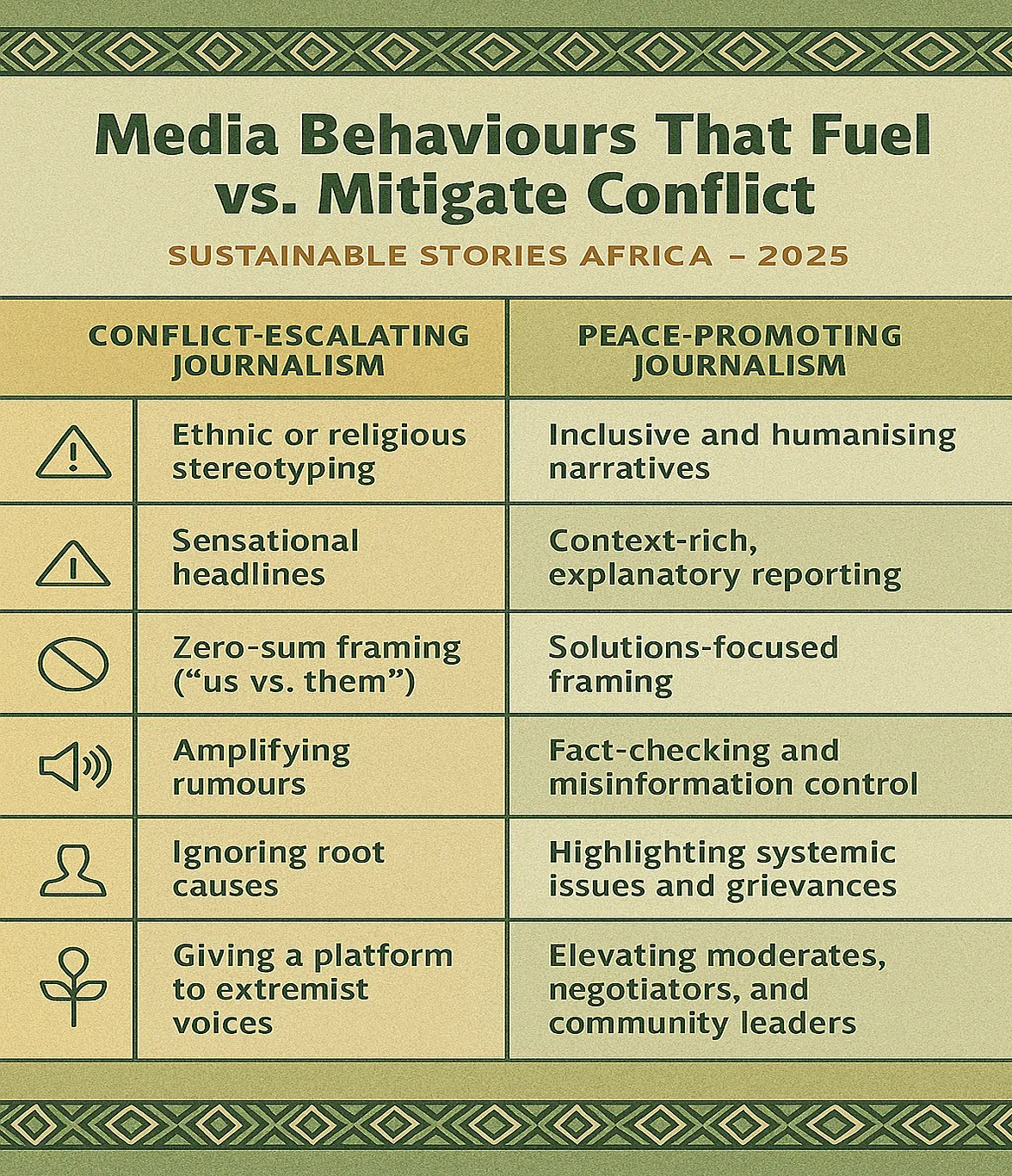
In conflict escalation, the media unintentionally acts as an instrument of primordialism (reinforcing group identities), instrumentalism (manipulating identity for political gain), and constructivism (reproducing harmful social narratives). These theoretical frames are not academic abstractions—they describe real-world dynamics in Nigeria, Kenya, Ethiopia, Sudan, and beyond.
Peace journalism, by contrast, reframes conflict as solvable. It shifts attention from battlefield casualties to structural drivers: poverty, governance failures, climate stresses, resource competition, exclusion, and historical injustice.
SSA Infographic - The Three Lenses of Journalism in Conflict
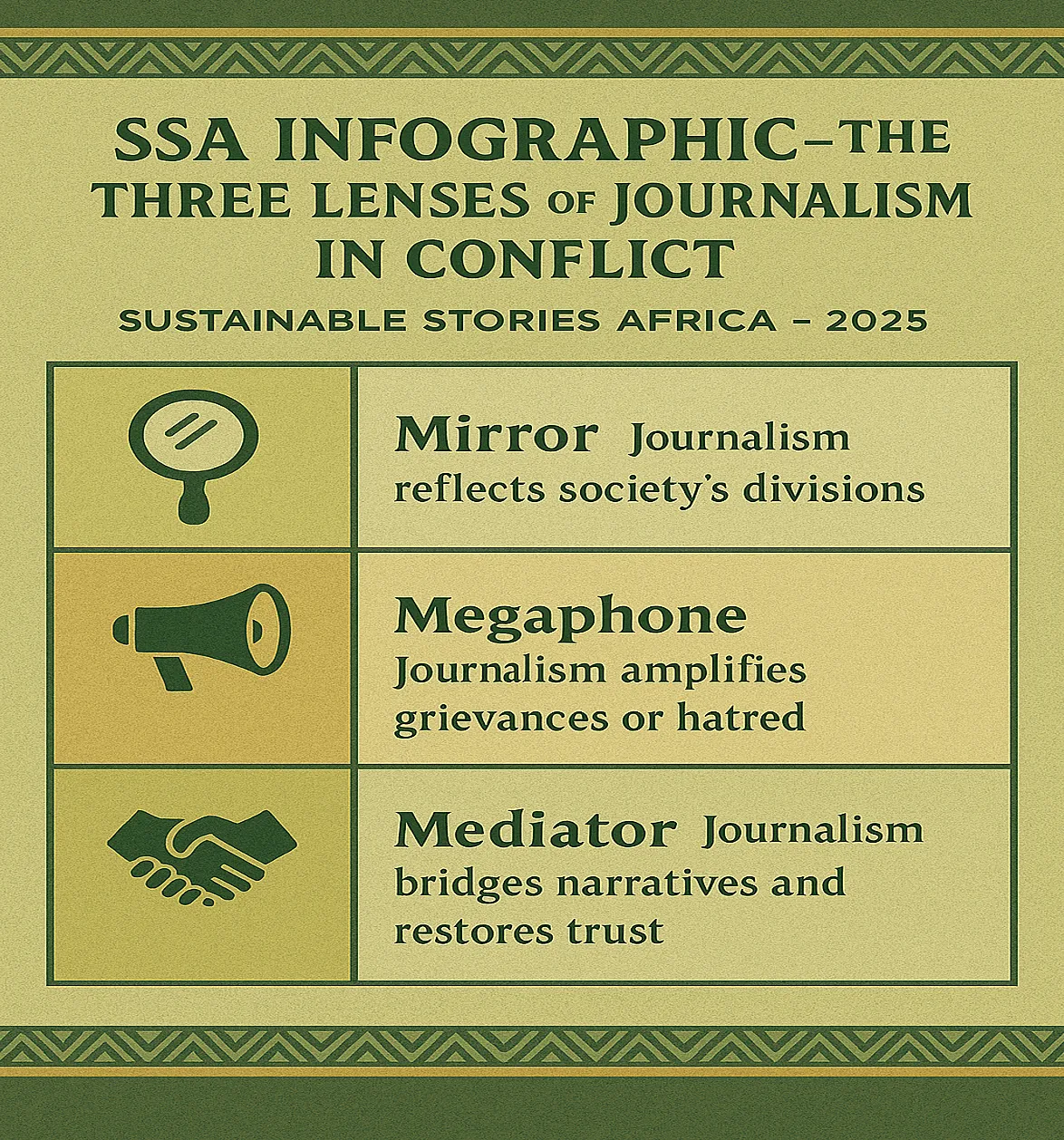
These lenses coexist. The question is which one's journalists choose, or are enabled to use.
Reimagining Newsrooms as Peace Infrastructure
What if newsrooms were treated as essential peacebuilding institutions? What if reporting standards were designed not only to inform but to reduce harm?
Peace journalism provides that path. It does not ask journalists to become activists—it asks them to become responsible narrators.
Key components include:
- Conflict Analysis – Moving beyond "who fought who" into why conflict persists.
- Humanisation – Giving voice to civilians, women, children, displaced people, and minorities.
- Dialogue Facilitation – Highlighting negotiation efforts, mediation actors, and reconciliation attempts.
- De-escalation – Avoiding language that inflames emotions or stereotypes.
- Intercultural Communication – Understanding "otherness" not as threat but as diversity.
- Ethical Digital Reporting – Countering deepfakes, manipulated narratives, and algorithmic polarisation.
The benefits are profound:
- Communities gain trust in information systems.
- Policymakers receive more accurate assessments of grievances.
- Insurgents lose narrative power.
- Peacebuilders and local mediators become more visible.
- Citizens recognise shared humanity across divides.
Peace journalism shifts the entire information ecosystem from reaction to reflection.
A New Mandate for Media – From Reporting Conflict to Reducing Harm
To activate journalism's peacebuilding potential, three pillars must be strengthened:
Newsroom Reform
- Integrate conflict-sensitive training into editorial guidelines.
- Replace sensational metrics with public-interest indicators.
- Establish verification desks to track rumours and manipulative content.
- Build partnerships with peace institutes, local mediators, and universities.
National and Regional Policy Support
- Media councils can require conflict-sensitive reporting standards.
- Regulators can strengthen digital misinformation governance. Governments must avoid weaponising media oversight for censorship.
- Regional blocs, such as ECOWAS, AU, should develop continental media frameworks for peace.
Community-Level Participation
- Encourage community radio, local storytellers, youth media clubs, and cultural mediators.
- Use multilingual and intercultural journalism to expand participation.
- Support citizen media literacy to reduce manipulation during elections or crises.
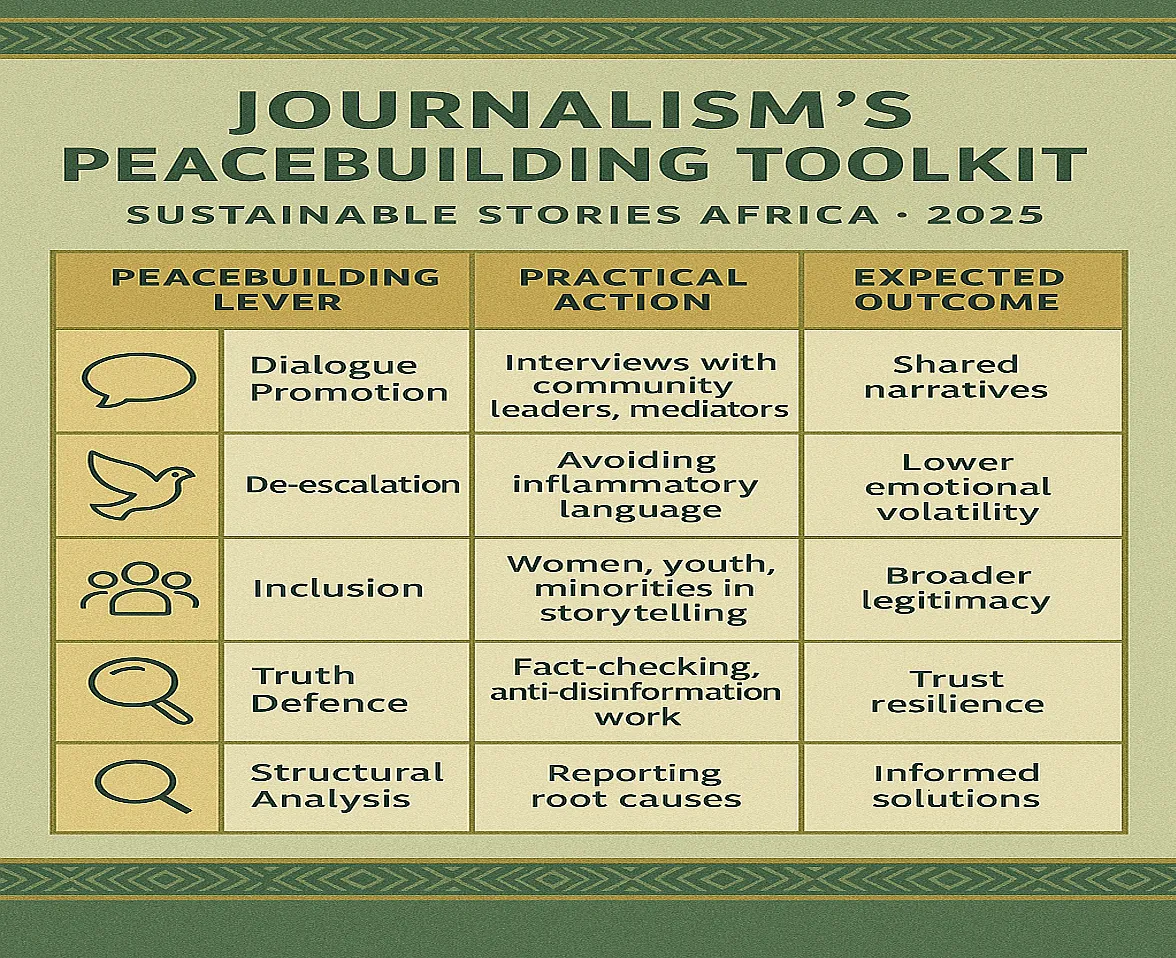
Journalism's Peacebuilding Toolkit
| Peacebuilding Lever | Practical Action | Expected Outcome |
|---|---|---|
| Dialogue Promotion | Interviews with community leaders, mediators | Shared narratives |
| De-escalation | Avoiding inflammatory language | Lower emotional volatility |
| Inclusion | Women, youth, minorities in storytelling | Broader legitimacy |
| Truth Defence | Fact-checking, anti-disinformation work | Trust resilience |
| Structural Analysis | Reporting root causes | Informed solutions |
The future of peace may well depend on how we report the present.
PATH FORWARD – Stronger Narratives, Safer Communities, Shared Futures
Peacebuilding begins with the stories societies tell about themselves. Journalism must evolve from passive observer to proactive mediator, shaping narratives that reduce harm and illuminate solutions.
By strengthening newsroom practices, supporting ethical reporting, investing in media literacy, and elevating inclusive dialogue, societies can reduce the emotional fuel that turns grievances into violence. A safer future requires media systems that empower understanding over division, context over sensation, and humanity over fear.