
Across boardrooms, investor roundtables and policy discussions, one topic continues to gather momentum, and that is impact-linked finance. Quietly but steadily, it is emerging as one of the most transformative trends shaping the future of ESG practice in Africa.
At its core, impact-linked finance represents a fundamental evolution in how we think about capital, accountability and value creation. Unlike traditional financing models that measure success by profit margins alone, this ties investment returns to clearly defined sustainability outcomes.
New Chapter in African ESG Finance
The paradigm of corporate finance across Africa is shifting. No longer are environmental, social and governance (ESG) metrics merely boxes to tick; they have become increasingly tied directly to the terms of finance.
This article highlights how "impact-linked finance" is gaining ground as an instrument to reward companies not just for financial returns, but for measurable sustainability outcomes.
For a continent grappling with the dual imperatives of growth and inclusion, this is significant. It reframes ESG not as cost or compliance, but as a reward driver of capital, competitiveness and credibility.
Why Impact-Linked Finance Matters
Measuring Impact and Value Creation, not Profits alone
Historically, ESG efforts in Africa have focused on disclosure, reporting and risk management.
However, what distinguishes this trend is the link between finance costs (interest rates, loan pricing) and sustainability outcomes such as emissions reduction, women's empowerment, and communities uplifted.
Sectoral Ripple Effects
- Energy: Blended finance and impact-linked debt can de-risk early-stage renewables.
- Agriculture: Sustainable farming practices tied to finance terms help food security and soil health.
- Manufacturing & real estate: Financing aligned with low-carbon technologies and green building standards.
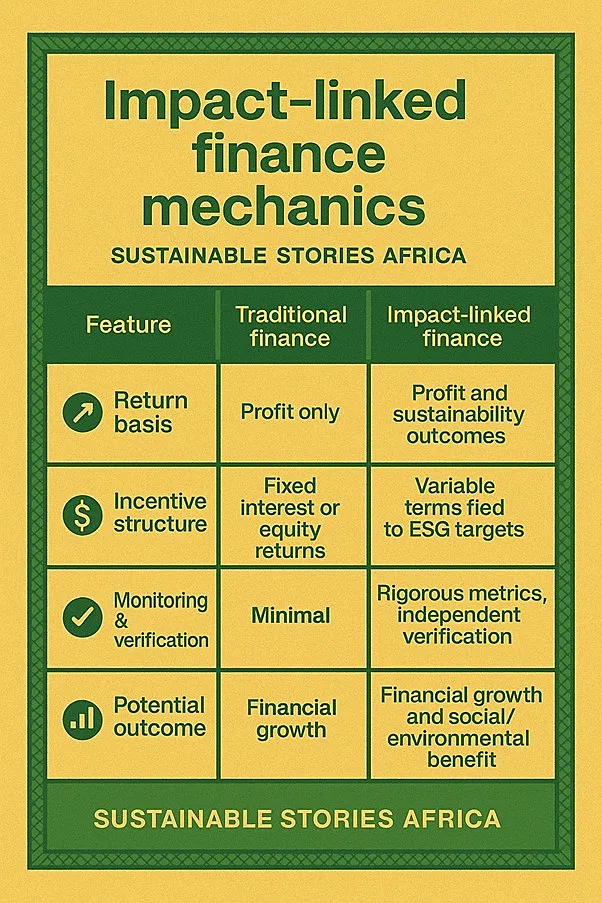
Impact-linked finance mechanics
| Feature | Traditional finance | Impact-linked finance |
|---|---|---|
| Return basis | Profit only | Profit and sustainability outcomes |
| Incentive structure | Fixed interest or equity returns | Variable terms tied to ESG targets |
| Monitoring & verification | Minimal | Rigorous metrics, independent verification |
| Potential outcome | Financial growth | Financial growth and social/environmental benefit |
Boards and executives must ask: How does our ESG strategy attract catalytic capital? Are measurable outcomes correctly linked to financing? Governance systems need to track and verify such outcomes regularly and credibly.
What Organisations Must Consider
Leadership and strategic alignment are non-negotiable, as impact-linked finance will test leadership maturity. Boards must evaluate:
- Can we integrate ESG outcomes into our financial DNA?
- Do we have credible metrics and verification systems?
- Will our financing instruments align with sustainability ambitions?
This is far more than "greenwashing". It requires transparency, third-party verification and a shift in corporate governance.
Implementation also means being selective: choosing ESG targets that are material to the business, measurable and aligned with sector realities.
For African firms, this may mean starting with one or two ESG priorities such as energy efficiency in manufacturing or gender inclusion in value chains.
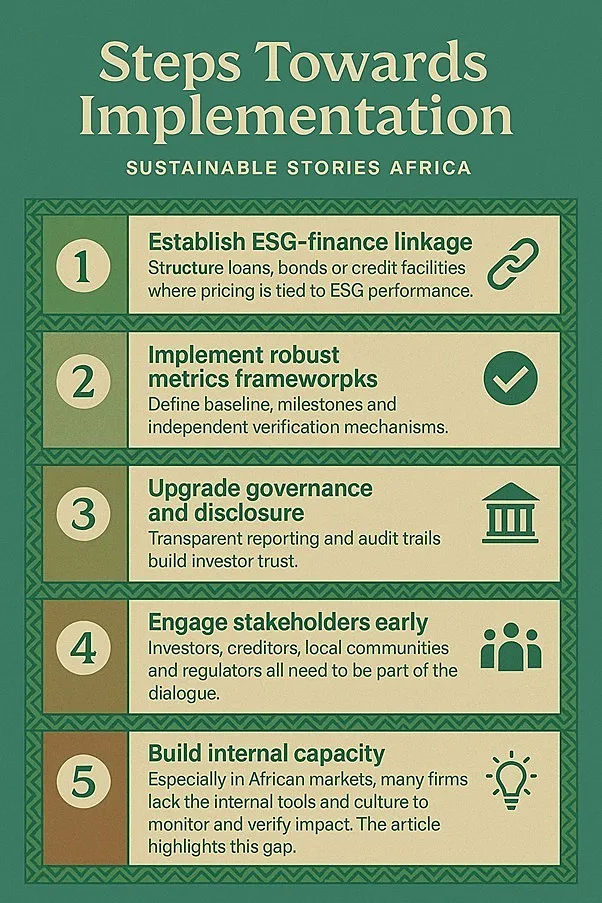
Steps Towards Implementation
Organisations should consider the following tactical actions:
- Establish ESG-finance linkage: Structure loans, bonds or credit facilities where pricing is tied to ESG performance.
- Implement robust metrics frameworks: Define baseline, milestones and independent verification mechanisms.
- Upgrade governance and disclosure: Transparent reporting and audit trails build investor trust.
- Engage stakeholders early: Investors, creditors, local communities and regulators all need to be part of the dialogue.
- Build internal capacity: Especially in African markets, many firms lack the internal tools and culture to monitor and verify impact. The article highlights this gap.
By acting now, companies can reposition ESG activities from being seen as cost centre, towards delivering on strategic growth as priority levers.
Path Forward – Unlocking Africa's Value-Driven Capital
Impact-linked finance is transforming African investment, guiding capital beyond sheer volume toward measurable, investable outcomes.
With robust governance and proven credibility, Africa stands poised to attract larger flows of capital, giving investors confidence to back projects where financial returns are matched by real impact.
Key enablers
- Regulatory clarity: Regulators must support frameworks for ESG-linked instruments and verification.
- Investor education: Global and local investors need to understand and price African-specific ESG outcomes.
- Standard-setting and verification: Without common standards, impact-linked financing risks are vague or inconsistent.
Macro-economic instability, weak governance, and voluntary disclosure regimes all pose challenges. Firms must avoid the trap of "impact and green, washing".
What stakeholders can do
- For policymakers: Enable frameworks, standardise reporting, and encourage blended finance.
- For investors: Demand transparency in metrics and link financing to outcomes, not just promises.
- For firms: Align strategy, build capacity and integrate ESG into the financial model.
Impact-linked finance is more than a trend; it will become the turning point. By tying capital to measurable sustainability outcomes, Africa's businesses and investors have a chance to reshape the conversation: from compliance to competitiveness; from intention to innovation; from reporting to real impact.
Culled From: https://businessday.ng/opinion/article/impact-linked-finance-shaping-africas-esg-future/