
Nigeria is undergoing a quiet corporate revolution as environmental, social, and governance (ESG) reporting shifts from a voluntary add-on to a strategic imperative.
A new analysis of the country's evolving ESG framework reveals a turning point: regulators, investors, and companies are aligning around transparency, value creation, and long-term resilience.
However, the gap between policy ambition and corporate practice remains wide, highlighting the urgent need for harmonised standards, stronger governance, and credible reporting.
Nigeria's ESG Awakening Demands Structural Reform
A wave of global sustainability rules ranging from the EU's CSRD to ISSB's IFRS S1 & S2 is reshaping how companies disclose their social and environmental impact.
But in Nigeria, the journey toward credible ESG reporting predates these global shifts. According to Catalysing Corporate Sustainability, the country began laying the groundwork as early as the 2000s through banking principles, governance codes, and stock-exchange guidelines designed to bring transparency and accountability into corporate culture.
By 2012, banks were mandated to adopt sustainable practices; by 2018, corporate governance codes placed sustainability firmly on board agendas; and by 2020, anti-corruption, transparency, and stakeholder accountability had become regulatory expectations.
However, the path forward remains uneven. While ESG awareness has grown, reporting maturity varies widely across sectors, and companies face pressure from investors demanding data that goes beyond "box-ticking."
Nigeria now stands at a strategic inflexion point: whether it can transform a fragmented reporting landscape into a robust ecosystem that supports capital mobilisation, drives competitiveness, and positions the country as an ESG leader in Africa.
Nigeria's ESG Reporting Revolution Has Begun, But the System Isn't Ready
Nigeria's ESG landscape is undergoing rapid expansion, driven by regulators, global investors, and a growing recognition that sustainability is inseparable from corporate performance. The report emphasises that ESG is no longer a moral preference—it is a strategic requirement shaping access to capital, corporate valuation, and long-term resilience.
Banks, oil and gas companies, manufacturers, and listed entities now face pressure to disclose climate risks, governance structures, anti-corruption safeguards, workplace data, and community impacts. But while adoption is rising, the system supporting ESG reporting is still fragmented, with inconsistent data quality, limited assurance practices, and varied interpretation of global frameworks.
Nigeria's corporate sector understands the "why" of sustainability; its challenge is the "how."
Inside Nigeria's ESG Framework: What's Working and What Still Isn't
The report provides a clear timeline of regulatory milestones that shaped Nigeria's sustainability reporting regime.
Key Milestones in Nigeria's ESG Reporting Evolution
| Year | Regulatory Shift | Impact |
|---|---|---|
| 2000s | Early awareness of sustainability | Foundations of ESG culture |
| 2012 | CBN Sustainable Banking Principles | Mandatory ESG integration for all banks |
| 2018 | NSE Sustainability Disclosure Guidelines | Standardised reporting for listed companies |
| 2018 | Corporate Governance Code (FRCN) | Sustainability is placed under board oversight |
| 2020 | SEC Governance Guidelines | Anti-corruption recognised as a sustainability issue |
| 2021–2023 | Alignment with global best practice | Rise of investor-driven ESG expectations |
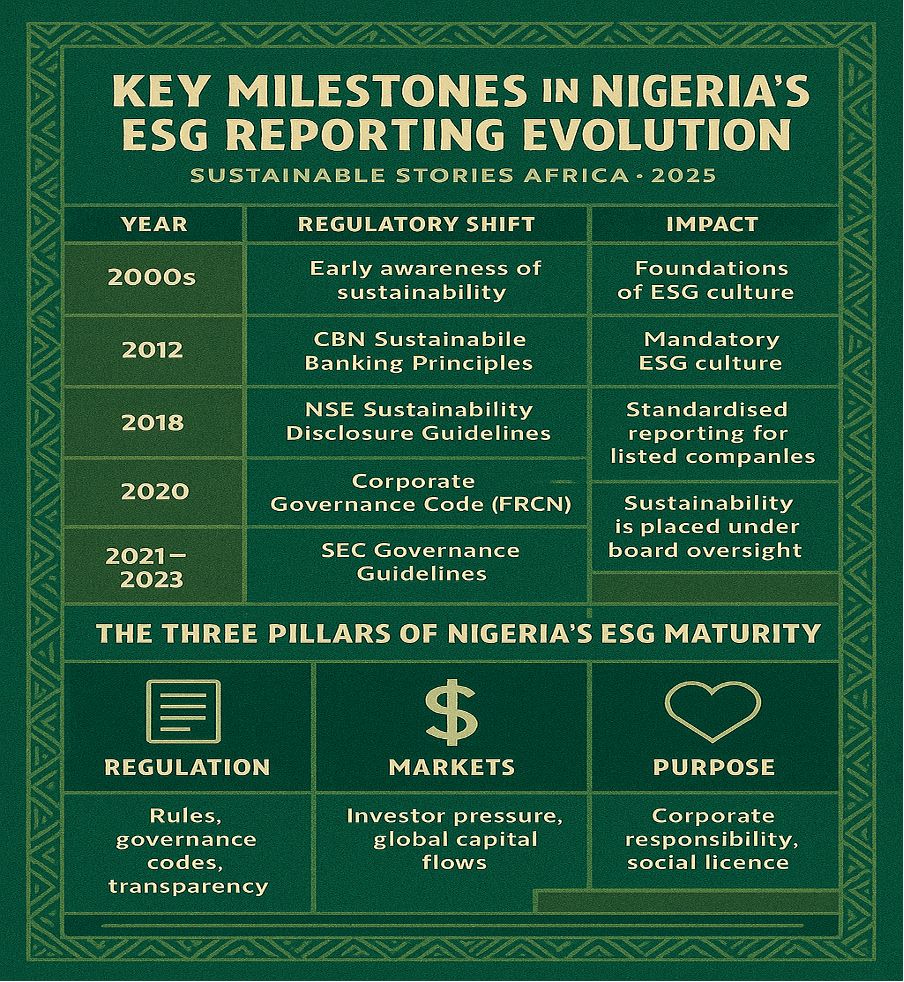
Nigeria's ESG evolution is being pulled by both regulation and markets. The country's largest corporates, especially in energy, banking, and telecommunications, now face investor scrutiny comparable to global peers.
But challenges remain:
- Sustainability data is inconsistent across sectors.
- Companies struggle to interpret international standards for the local context.
- Sector-specific ESG risks—oil pollution, bribery, inequality—require tailored reporting.
- Board members still vary in ESG fluency and oversight capacity.
Nigeria's ESG ecosystem is maturing, just not evenly.
Why Nigeria Must Strengthen ESG to Compete Globally
The analysis emphasises a compelling truth: ESG is now a competitiveness issue. Companies that integrate sustainability into strategy outperform peers on resilience, investor trust, and regulatory compliance. Those that lag risk losing access to global markets, particularly as the EU, UK, and US expand mandatory disclosure rules.
Nigeria's future ESG leadership requires:
- Sector-Specific Frameworks – Oil & gas, agriculture, manufacturing, and infrastructure each face distinct ESG risks—from methane emissions to land use and community relations. Uniform reporting no longer suffices.
- Stronger Governance and Board Accountability – The 2018 Corporate Governance Code already mandates ESG oversight. Boards must now move beyond compliance into active stewardship.
- Technology-Enabled Reporting – Artificial intelligence, blockchain, and digital tools can enhance data quality, traceability, and verification—improving investor confidence and reducing greenwashing.
- Integrated Reporting Models – Nigeria's future lies in frameworks that combine financial and non-financial data, offering a holistic picture of performance.
Nigeria can position itself as the ESG hub of West Africa, but only if it builds credibility now.
The Roadmap: How Nigeria Can Strengthen Its Corporate ESG Future
Based on the report's insights, Nigeria can accelerate ESG maturity through six critical actions:
- Adopt a Unified National ESG Reporting Framework – A consistent standard across all sectors would reduce fragmentation and improve comparability for investors.
- Build Reporting Capacity Within Companies – Training sustainability teams, equipping boards, and integrating ESG into risk management systems will close internal capability gaps.
- Prioritise Assurance and Verification – Independent assurance can elevate the credibility of sustainability reports, reduce misinformation risk, and improve investor trust.
- Align ESG With Value Creation – Companies should communicate how sustainability initiatives reduce costs, enhance productivity, or unlock growth, not just list activities.
- Strengthen Regulatory Enforcement – Nigeria's sustainability rules must evolve from guidelines into enforceable standards with penalties for false or misleading disclosures.
Six Levers for Nigeria's ESG Leap
| Lever | Purpose | Expected Outcome |
|---|---|---|
| National Standard | Unify disclosure | Better comparability |
| Capacity Building | Improve skills | Higher data quality |
| Assurance | Verify claims | Trust, investor confidence |
| Technology | Digitise reporting | Precision, transparency |
| Governance | Board oversight | Stronger accountability |
| Sector Focus | Tailored metrics | Meaningful reporting |
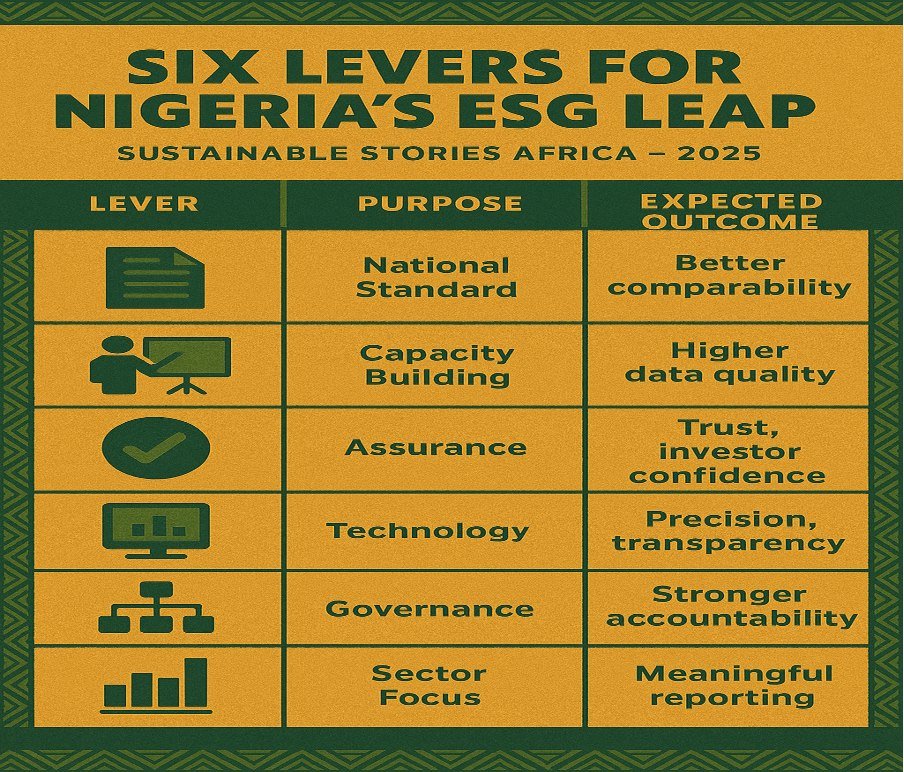
PATH FORWARD – Unify Standards, Build Capacity, Deepen Trust
Nigeria is entering a decisive phase in its sustainability evolution. With rising investor expectations and expanding global regulations, companies must move beyond symbolic ESG commitments toward credible, high-quality reporting.
Strengthening governance, adopting unified frameworks, and leveraging technology will create a transparent, competitive corporate ecosystem. The future belongs to Nigerian companies that understand sustainability not as compliance, but as strategy and as a pathway to long-term value.