Nigeria's economy is stabilising after years of volatility, driven by bold macroeconomic reforms, tighter monetary policy, and foreign-exchange liberalisation. Growth has picked up, revenues have surged, and fiscal balances have improved.
However, the World Bank warns that stability alone will not deliver prosperity. With increasing poverty, falling productivity, and job creation lagging population growth, Nigeria's next challenge will be to turn this reform momentum into broad-based, inclusive growth.
Stability Achieved, Inclusion Still Elusive
Nigeria is emerging from one of its most turbulent economic periods in decades with a rare asset: macroeconomic stability. After years of distortionary subsidies, exchange-rate fragmentation, and fiscal fragility, reforms implemented since 2023 are beginning to show perceived results. Growth has strengthened, inflation, though still high, is perceived to be easing, and Nigeria's external position has improved.
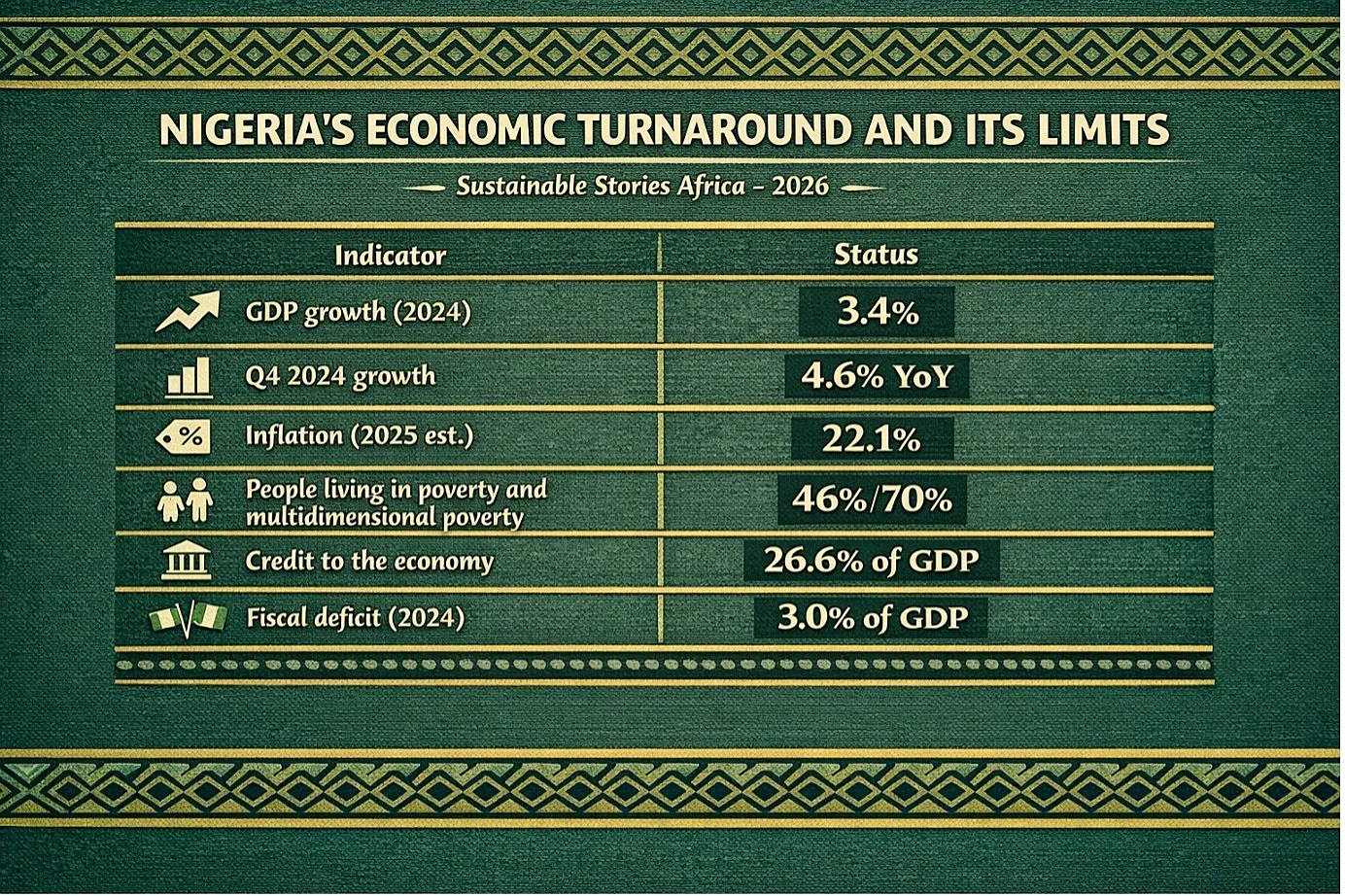
According to the World Bank's Nigeria Development Update (May 2025), real GDP growth reached 3.4% in 2024, the strongest performance since 2014 outside the post-COVID rebound. Foreign-exchange reforms have stabilised the naira, revenues have surged, and the consolidated fiscal deficit narrowed sharply to 3.0% of GDP.
But beneath these gains lies a harder truth. Economic growth remains uneven, productivity is declining, and nearly 46% of Nigerians still live below the international poverty line, while almost 70% live in multi-dimensional poverty.
The central question is no longer whether Nigeria can stabilise, but whether it can convert stability into inclusive growth that creates jobs, raises incomes, and restores social confidence.
Nigeria Has Stopped the Bleeding
After years of macroeconomic imbalance, Nigeria's economy is finally regaining its footing. Growth accelerated to 4.6% year-on-year in Q4 2024, driven by a recovery in oil production and strong expansion in services, particularly ICT and finance. Oil output rose to an average of 1.6 million barrels per day in 2024, its first sustained increase since 2019.
Fiscal performance has improved even more dramatically. Federation revenues nearly doubled from N16.8 trillion in 2023 to N31.9 trillion in 2024, mostly due to the almost 300% exchange rate devaluation, reflecting FX unification, subsidy removal, and perceived stronger revenue administration.
As a result, Nigeria's debt service-to-revenue ratio fell below 40%, down from nearly 100% in 2022.
These may not be cosmetic gains. They could represent a decisive break from policies that drained public finances while benefitting a narrow segment of the population.
Why Growth Still Feels Distant for Most Nigerians
Growth Without Jobs – Despite stronger headline numbers, growth remains poorly aligned with employment. Services, especially finance and ICT, account for more than half of GDP growth, yet these sectors absorb only a small fraction of Nigeria's rapidly expanding labour force. Agriculture grew by just 1.2% in 2024, while the non-oil industry stagnated at 1.4%, constrained by high input costs, unreliable power, insecurity, and weak logistics.
At the same time, Nigeria's working-age population is expanding faster than productivity. Over the past decade, value added has grown more slowly than employment, resulting in declining productivity across most sectors.
Inflation and the Cost-of-Living Squeeze – Inflation remains Nigeria's most immediate social risk. Although monetary tightening has slowed price acceleration, inflation was still expected to average 22.1% in 2025. High food and energy costs have eroded purchasing power, particularly in urban areas, pushing millions into poverty since 2018.
The Central Bank of Nigeria has raised the policy rate by 875 basis points since early 2024 and maintained an exceptionally tight stance. While necessary to restore credibility, high interest rates have also curtailed private-sector credit and investment.
A Shallow Financial System – Nigeria's financial sector remains healthy, however, shallow. Total credit to the public and private sectors stands at just 26.6% of GDP, one of the lowest ratios among peer economies. Capital markets remain underdeveloped, and banking intermediation is constrained by high reserve requirements and elevated government borrowing.
As a result, businesses, especially MSMEs, struggle to access long-term finance, limiting expansion, innovation, and job creation.
NIGERIA'S ECONOMIC TURNAROUND AND ITS LIMITS
| Indicator | Status |
|---|---|
| GDP growth (2024) | 3.4% |
| Q4 2024 growth | 4.6% YoY |
| Inflation (2025 est.) | 22.1% |
| People living in poverty and multidimensional poverty | 46%/70% |
| Credit to the economy | 26.6% of GDP |
| Fiscal deficit (2024) | 3.0% of GDP |
What Inclusive Growth Could Deliver
The report is explicit: macroeconomic stability is a launching pad, not an endpoint. If Nigeria can sustain reforms and deepen structural change, the dividends could be transformative. Higher productivity, competitive markets, and better infrastructure would enable firms to grow, exports to diversify, and incomes to rise.
Redirecting public spending toward education, health, social protection, and infrastructure could break inter-generational poverty traps. Strengthening social safety nets, especially targeted cash transfers, would cushion reform costs while enabling households to re-enter productive activity.
Most importantly, a private-sector-led growth model could unlock millions of jobs, something Nigeria's public sector cannot deliver alone.
The Reform Agenda That Must Follow
The World Bank outlines a two-part agenda:
First, build an empowering public sector by consolidating macro-fiscal reforms, improving transparency, and spending better on development priorities. This includes ensuring full transfer of subsidy savings, strengthening tax administration, and improving public investment management.
Second, enable private-sector development by fixing infrastructure gaps, fostering competition, lowering trade barriers, expanding access to finance, and modernising key sectors such as agriculture, energy, and digital services.
Crucially, these reforms must be sequenced, coordinated, and insulated from political cycles as the 2027 elections approach.
PATH FORWARD: Turning Stability Into Shared Prosperity
Nigeria has done the hard part: stabilising an economy long distorted by subsidies and FX misalignment. The more difficult task is translating stability into jobs, productivity, and rising living standards.
Inclusive growth will depend on implementing disciplined reforms, private-sector confidence, and sustained investment in people and infrastructure.
The momentum exists. However, whether it turns to lasting prosperity depends on what Nigeria does next.