As climate finance debates grow louder, the OPEC Fund has quietly crossed a threshold. In 2024, nearly 40% of its approvals were climate-related, with a decisive shift toward adaptation, food security and resilience in the Global South.
This is not climate finance as symbolism, but as a developmental survival strategy, raising hard questions about scale, private capital and who truly carries climate risk.
This story is about climate realism, not rhetoric.
Climate Finance Meets Development Reality
Climate finance is no longer a future promise for developing economies; it is a present constraint. Across Africa, Asia and small island states, climate shocks are eroding development gains faster than traditional finance can rebuild them.
Against this backdrop, the OPEC Fund for International Development has repositioned climate action from a niche portfolio to a central development instrument.
In 2024, the OPEC Fund approved a record $863.7 million in climate finance, which constituted 39.3% of its total annual approvals, nearly doubling its baseline contribution for 2018 – 2021.
This acceleration reflects a deeper shift: climate finance is being treated less as an environmental add-on and more as a macroeconomic development stabiliser, particularly for food systems, energy access and institutional resilience.
However, the numbers also expose a structural tension. Public finance dominates. Private capital remains marginal. And while ambition is rising, global climate finance still falls dramatically short of what vulnerable economies require.
The trajectory of the OPEC Fund's offers both a blueprint and a warning for climate finance in the Global South.
Climate Finance Is Becoming Development Finance
The OPEC Fund's 2025 Climate Finance Report makes one fact unmistakable: climate action is now embedded across its operations. From agriculture and energy to transport and policy-based lending, climate considerations are no longer siloed.
In 2024 alone, 44 of 49 approved projects contributed to climate finance. Mitigation accounted for 60.8%, while adaptation reached 39.2%, a more balanced mix when compared to earlier years.
Agriculture emerged as a leading sector, reflecting the rising challenges encountered with increased food security risks linked to droughts, floods and temperature volatility.
SSA Insight: For vulnerable economies, climate finance is increasingly about protecting livelihoods, not just reducing emissions.
Following the Money – What the Numbers Reveal
Despite record growth, the structure of OPEC Fund climate finance reveals familiar constraints. Public sector projects accounted for 89.4% of climate finance in 2024. Private sector participation stood at a meagre 10.6%.
This imbalance mirrors a broader global challenge. According to CPI and IPCC estimates cited in the report, climate finance must rise fivefold to meet a 1.5°C pathway. Emerging markets alone will require over $2.4 trillion annually by 2030, which is much more than the current public balance sheets.
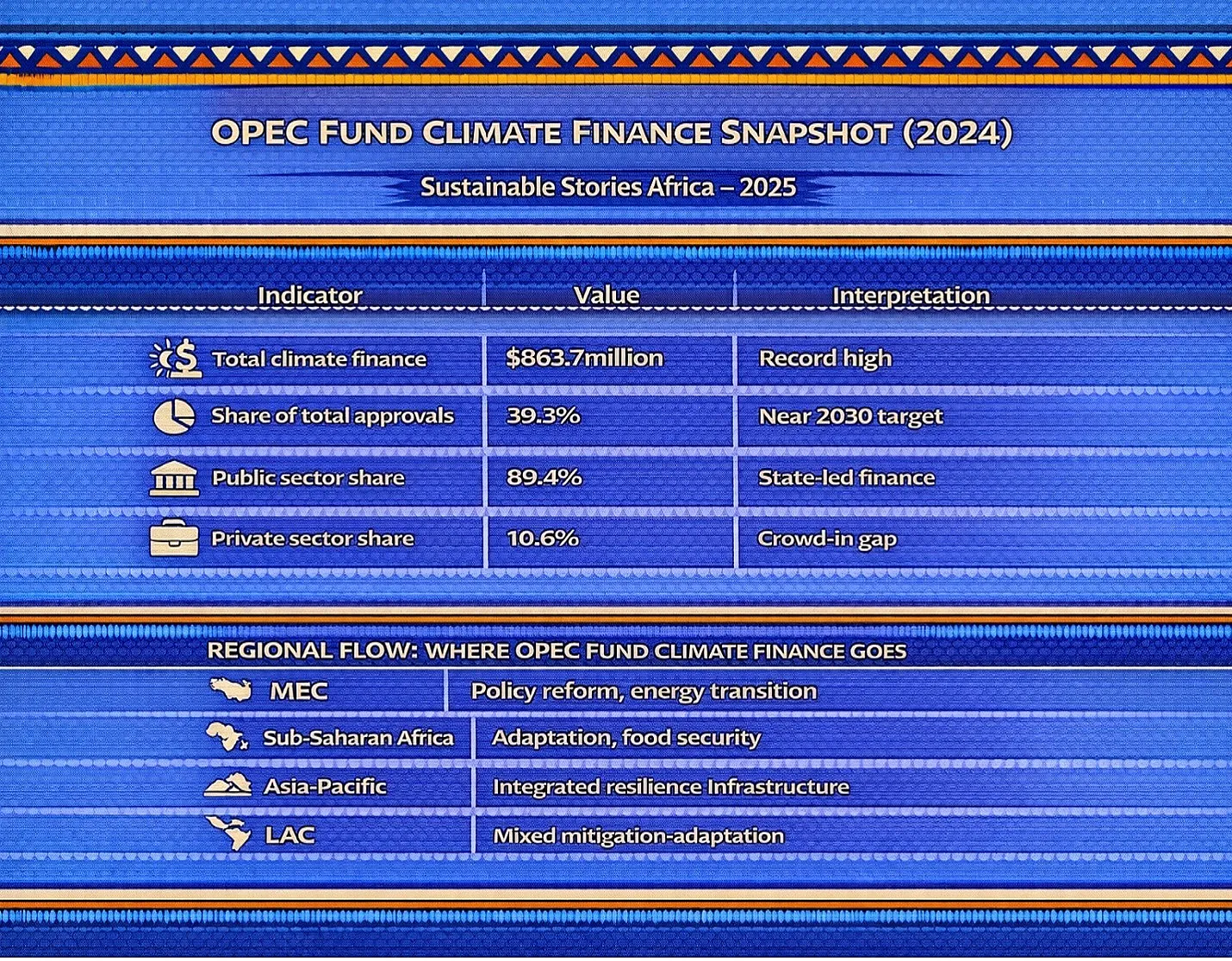
OPEC Fund Climate Finance Snapshot (2024)
| Indicator | Value | Interpretation |
|---|---|---|
| Total climate finance | $863.7m illion | Record high |
| Share of total approvals | 39.3% | Near 2030 target |
| Public sector share | 89.4% | State-led finance |
| Private sector share | 10.6% | Crowd-in gap |
SSA Insight: Scaling climate finance without private capital will hit fiscal limits.
Africa and Vulnerable Regions Move Centre Stage
Regional data underscore a strategic pivot. Sub-Saharan Africa received approximately $280 million in climate finance in 2024, making it the second-largest recipient after the Middle East, Eastern Europe and Central Asia.
The emphasis reflects rising climate exposure, which includes drought-driven food insecurity, fragile infrastructure and limited fiscal buffers.
Projects in Tanzania, Senegal, Malawi and Zimbabwe illustrate a focus on climate-smart agriculture, water systems and rural resilience.
SSA Insight: Climate finance is increasingly flowing to where development risks are highest.
Partnerships, Innovation and South-South Logic
The OPEC Fund's Climate Action Plan signals a shift from transactional lending to partnership-driven finance. Flagship initiatives, including the Climate Finance and Energy Innovation Hub, the Food Security and Climate Adaptation Facility and the Nature Solutions Finance Hub, all aimed at mobilising blended finance and technical capacity alongside capital.
A $1 billion pledge to the Global Drought Resilience Partnership and the launch of the Island Resilience Facility highlight a growing focus on systemic risks rather than isolated projects.
However, even these innovations confront limits. Private capital mobilisation remains slow, constrained by currency risk, project bankability and regulatory fragmentation.
Public Finance Cannot Carry Climate Alone
The OPEC Fund's progress exposes a structural truth: public development banks can lead, but they cannot scale climate finance alone.
With global needs approaching $8 – $10 trillion annually, public capital must be catalytic, not substitutive.
Policy-based lending, climate screening and MDB alignment will help de-risk investments, but only if they translate into bankable pipelines that institutional investors can trust.
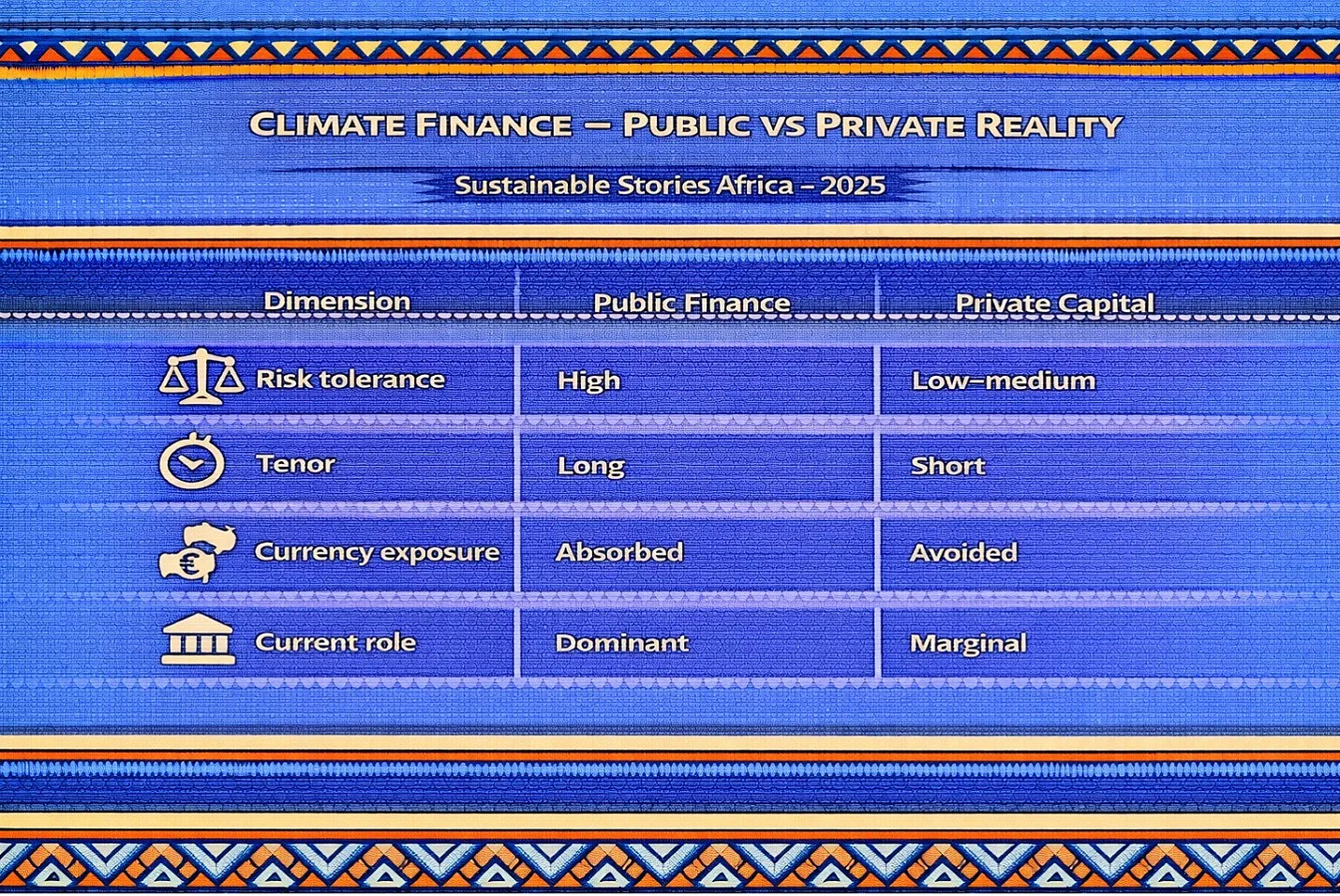
Climate Finance – Public vs Private Reality
| Dimension | Public Finance | Private Capital |
|---|---|---|
| Risk tolerance | High | Low–medium |
| Tenor | Long | Short |
| Currency exposure | Absorbed | Avoided |
| Current role | Dominant | Marginal |
SSA Insight: The crowd-in problem is structural, not rhetorical.
What Must Change
For climate finance to scale, three shifts are required.
- First, a stronger local currency and guarantee mechanisms to reduce FX risk.
- Second, clearer project pipelines aligned with national climate strategies.
- Third, a deeper coordination between MDBs, domestic financial institutions and regulators.
Without these, climate finance risks becoming a permanent public-sector burden, especially when fiscal space is shrinking.
PATH FORWARD: Scaling Climate Finance With Discipline
The OPEC Fund's climate pivot shows what is possible when development and climate agendas align.
The next phase must focus on mobilising private capital, strengthening project pipelines and protecting fiscal sustainability.
Climate ambition without financial discipline will not endure; however, disciplined climate finance systems can reshape development trajectories.