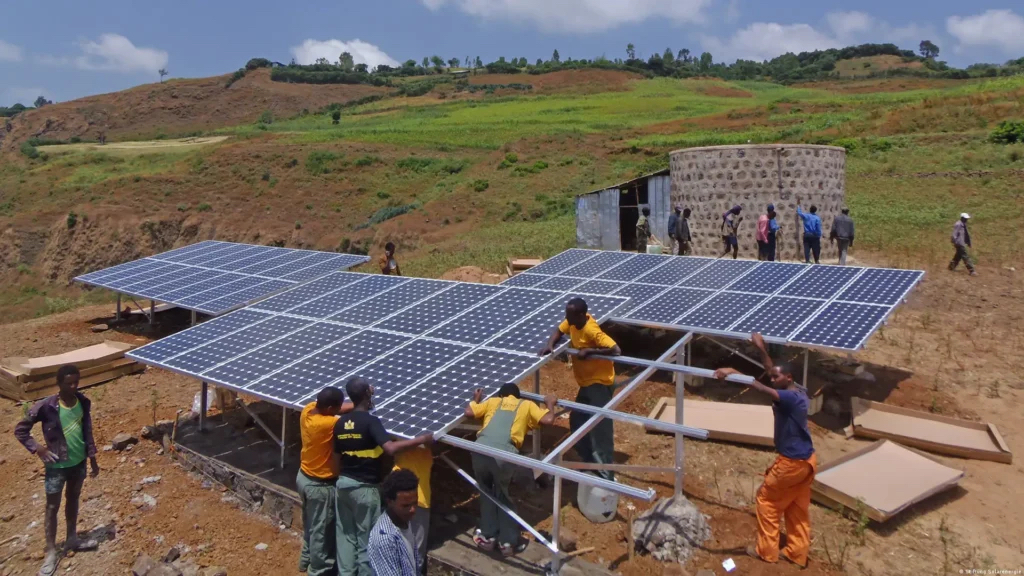
Africa’s solar expansion is accelerating despite the withdrawal of $9.7 billion in U.S. energy transition funding.
Private investors, domestic policies, and falling solar costs are filling the financing gap, reshaping Africa’s energy transition trajectory.
The shift signals a structural turning point, as solar becomes central to energy security, industrial growth, and climate resilience across the continent.
Solar Growth Defies Global Funding Shock
Africa’s solar adoption is accelerating rapidly, even after the cancellation of $9.7 billion in planned U.S. climate and energy funding disrupted expected transition pathways.
The funding rollback initially raised concerns about delayed electrification and reduced climate investment across emerging markets.
However, solar deployment across African markets has continued expanding, driven by declining technology costs, rising electricity demand, and structural energy deficits.
Countries such as Nigeria, South Africa, Egypt, Morocco, and Kenya are increasingly adopting solar to reduce reliance on expensive fossil fuel imports and unstable grid systems.
The shift underscores a broader structural reality: Africa’s solar transition is no longer solely dependent on international public finance but is increasingly driven by domestic demand and private capital mobilisation.
Private Capital and Policy Drive Solar Momentum
Solar energy adoption is accelerating as private sector investment, innovative financing models, and supportive policy reforms reshape Africa’s energy landscape. Commercial and industrial solar installations are expanding rapidly as businesses seek protection from grid unreliability and rising fuel costs.
Solar’s economic competitiveness continues to improve due to falling equipment costs and improved access to financing.
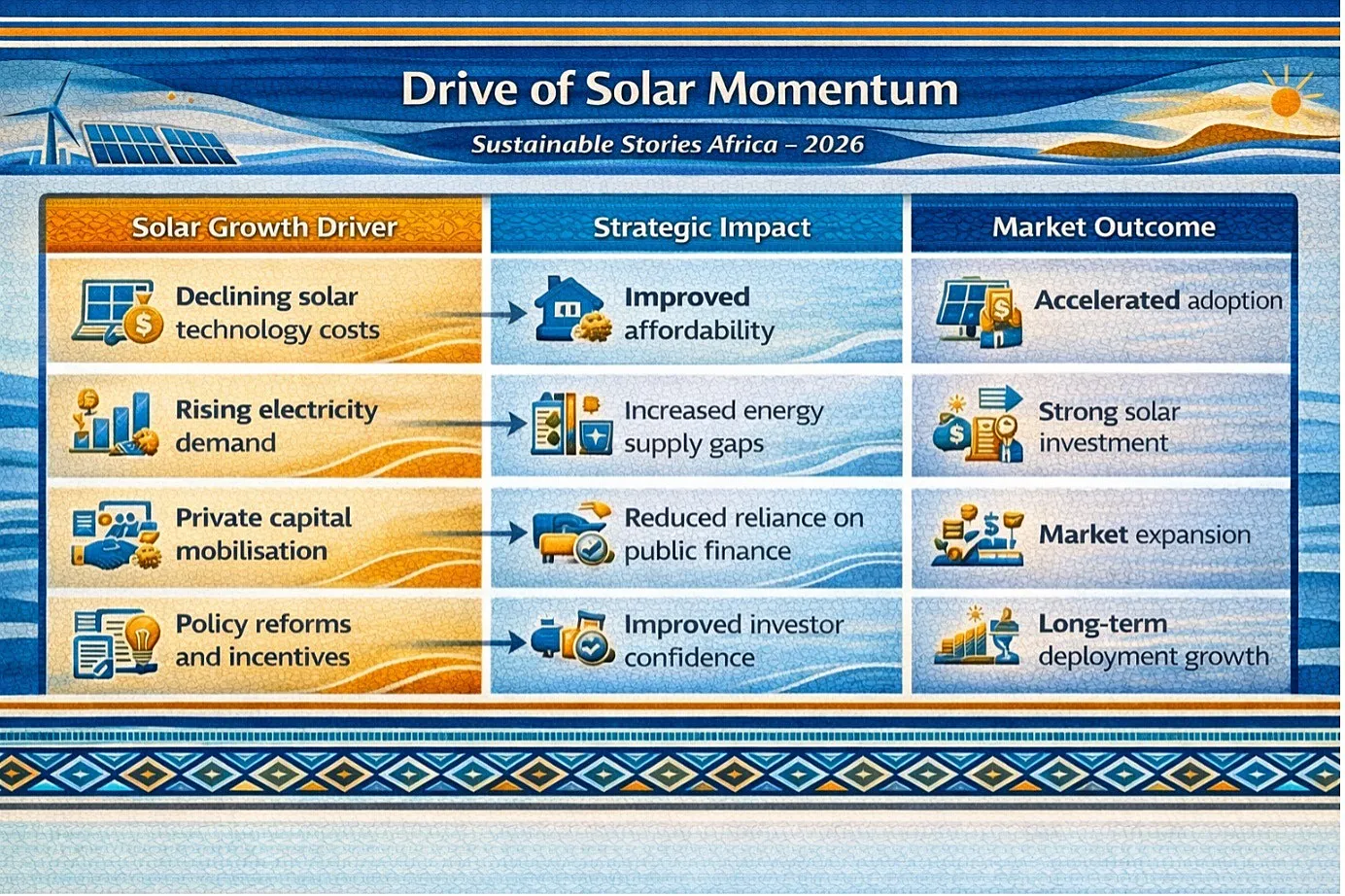
Solar Growth Driver | Strategic Impact | Market Outcome |
|---|---|---|
Declining solar technology costs | Improved affordability | Accelerated adoption |
Rising electricity demand | Increased energy supply gaps | Strong solar investment |
Private capital mobilisation | Reduced reliance on public finance | Market expansion |
Policy reforms and incentives | Improved investor confidence | Long-term deployment growth |
Distributed solar solutions, including mini-grids and rooftop installations, are expanding access to electricity across underserved communities.
This decentralised model is accelerating electrification while strengthening energy resilience.
Africa’s structural electricity deficit, combined with growing industrial demand, continues to drive the adoption of solar as a strategic necessity rather than a policy option.
Solar Transition Unlocks Economic Transformation Potential
Solar energy is emerging as a foundational pillar of Africa’s long-term economic transformation.
Reliable access to electricity supports industrial productivity, job creation, and the expansion of digital infrastructure.
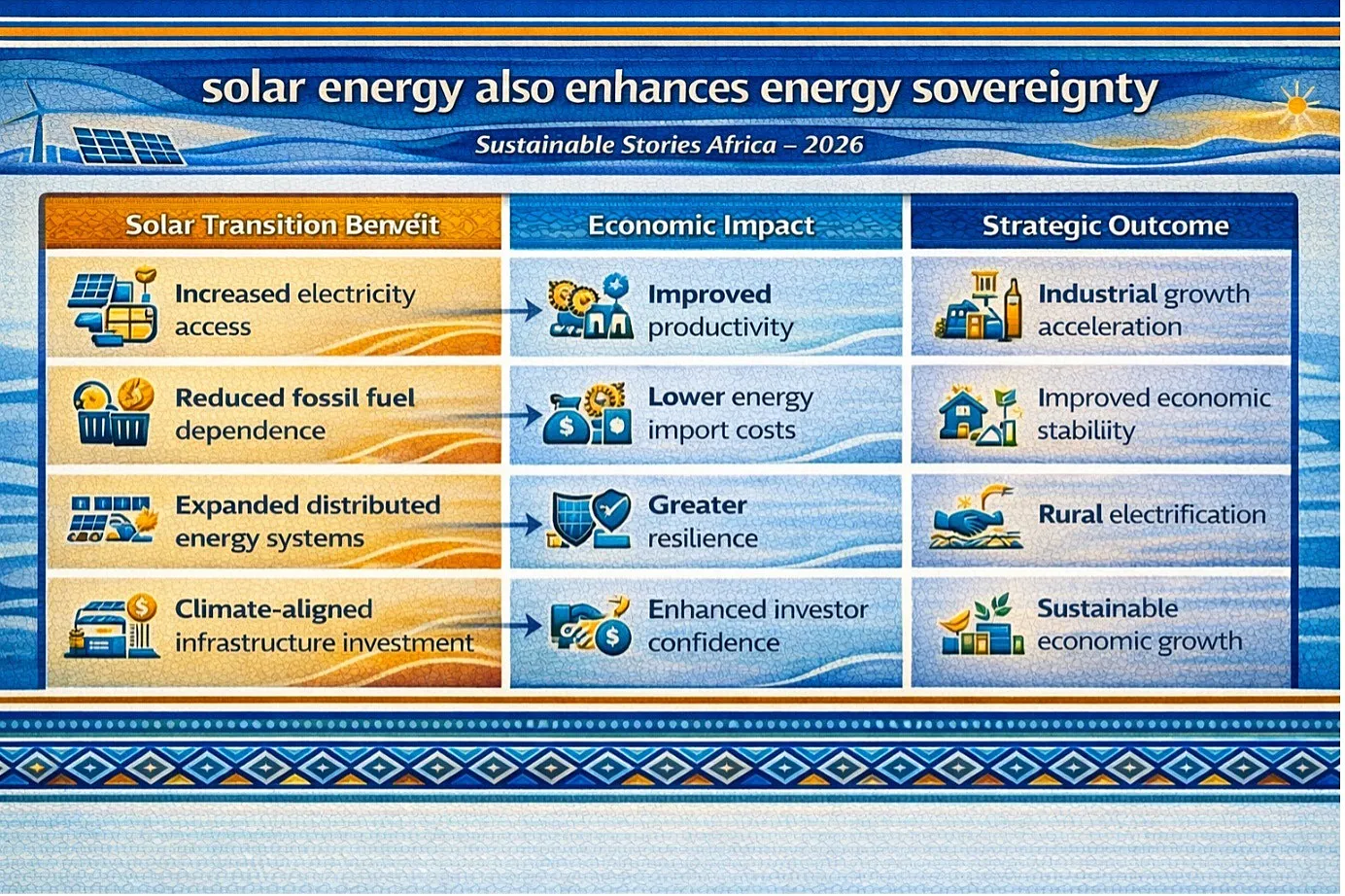
The deployment of solar energy also enhances energy sovereignty by reducing reliance on imported fossil fuels, improving trade balances, and strengthening macroeconomic resilience.
Solar Transition Benefit | Economic Impact | Strategic Outcome |
|---|---|---|
Increased electricity access | Improved productivity | Industrial growth acceleration |
Reduced fossil fuel dependence | Lower energy import costs | Improved economic stability |
Expanded distributed energy systems | Greater resilience | Rural electrification |
Climate-aligned infrastructure investment | Enhanced investor confidence | Sustainable economic growth |
Countries that invest early in solar infrastructure are positioning themselves to capture future green industrial opportunities, including manufacturing, green hydrogen, and digital economy expansion.
Solar’s scalability and cost competitiveness make it uniquely suited to Africa’s decentralised energy needs.
Africa Must Accelerate Solar Investment Mobilisation
To sustain momentum, African governments, investors, and development partners must accelerate capital mobilisation, infrastructure deployment, and regulatory reforms supporting solar expansion.
Stable policy frameworks, improved grid integration, and access to affordable financing will be strategic to unlocking the full potential of solar.
Financial innovation, including blended finance, green bonds, and private equity participation, can accelerate the deployment of integrated solar energy systems.
Africa’s solar expansion demonstrates growing structural independence from external funding shocks. However, maintaining this trajectory will require sustained investment, policy alignment, and institutional support.
Solar energy is rapidly becoming the backbone of Africa’s energy transition and economic future.
Path Forward – Solar Momentum Requires Sustained Policy Support
Governments must strengthen solar policy frameworks, mobilise private capital, and expand distributed energy infrastructure to sustain deployment momentum.
Accelerated solar investment can enhance energy security, drive industrial growth, and support long-term climate resilience across African economies.
Culled From: Africa's solar adoption surges one year after Trump scraps $9.7 billion funding - Energy in Africa