A coalition of state attorneys general and environmental groups has sued the U.S. Environmental Protection Agency over efforts to rescind its landmark greenhouse gas endangerment finding.
The legal challenge strikes at the heart of federal climate regulation, with implications for corporate compliance, energy markets and investor certainty.
At stake is whether the scientific and legal foundation underpinning U.S. climate policy remains intact.
EPA Lawsuit Tests Climate Regulation Foundations
The U.S. Environmental Protection Agency (EPA) is facing legal action following its decision to reconsider or rescind its 2009 endangerment finding, the determination that greenhouse gases pose a threat to public health and welfare.
Environmental organisations and several state attorneys general argue that overturning the finding would violate the Clean Air Act and decades of established climate science.
The lawsuit, filed in federal court, contends that the EPA cannot lawfully discard a science-based determination without robust evidence and due process.
The endangerment finding forms the backbone of federal greenhouse gas regulation. It has underpinned vehicle emissions standards, power plant rules and methane controls for more than a decade.
Legal experts say its removal could significantly curtail the federal government’s authority to regulate carbon emissions.
Climate Authority Under Legal Fire
The 2009 endangerment finding concluded that carbon dioxide and other greenhouse gases pose a threat to public health.
That determination followed a Supreme Court ruling requiring the EPA to assess climate risks under the Clean Air Act.
Plaintiffs argue that rescinding the finding would destabilise climate governance, weaken emissions standards and create regulatory confusion for businesses operating under federal rules.
Industry groups are watching closely. While some fossil fuel interests have long opposed federal climate mandates, many large corporations now rely on regulatory predictability for long-term capital planning.
Regulatory Volatility Meets Investor Expectations
The lawsuit highlights broader tension between political cycles and the durability of climate policy. ESG investors are increasingly factoring regulatory stability into risk assessments.
Legal analysts suggest that rescinding the finding could:
- Trigger immediate legal challenges
- Stall existing climate regulations
- Increase compliance uncertainty across sectors
The stakes extend beyond environmental policy. Corporate disclosures aligned with frameworks such as the Task Force on Climate-related Financial Disclosures (TCFD) and emerging IFRS sustainability standards assume a stable regulatory trajectory.
Policy reversal risks misalignment between federal oversight and market expectations.
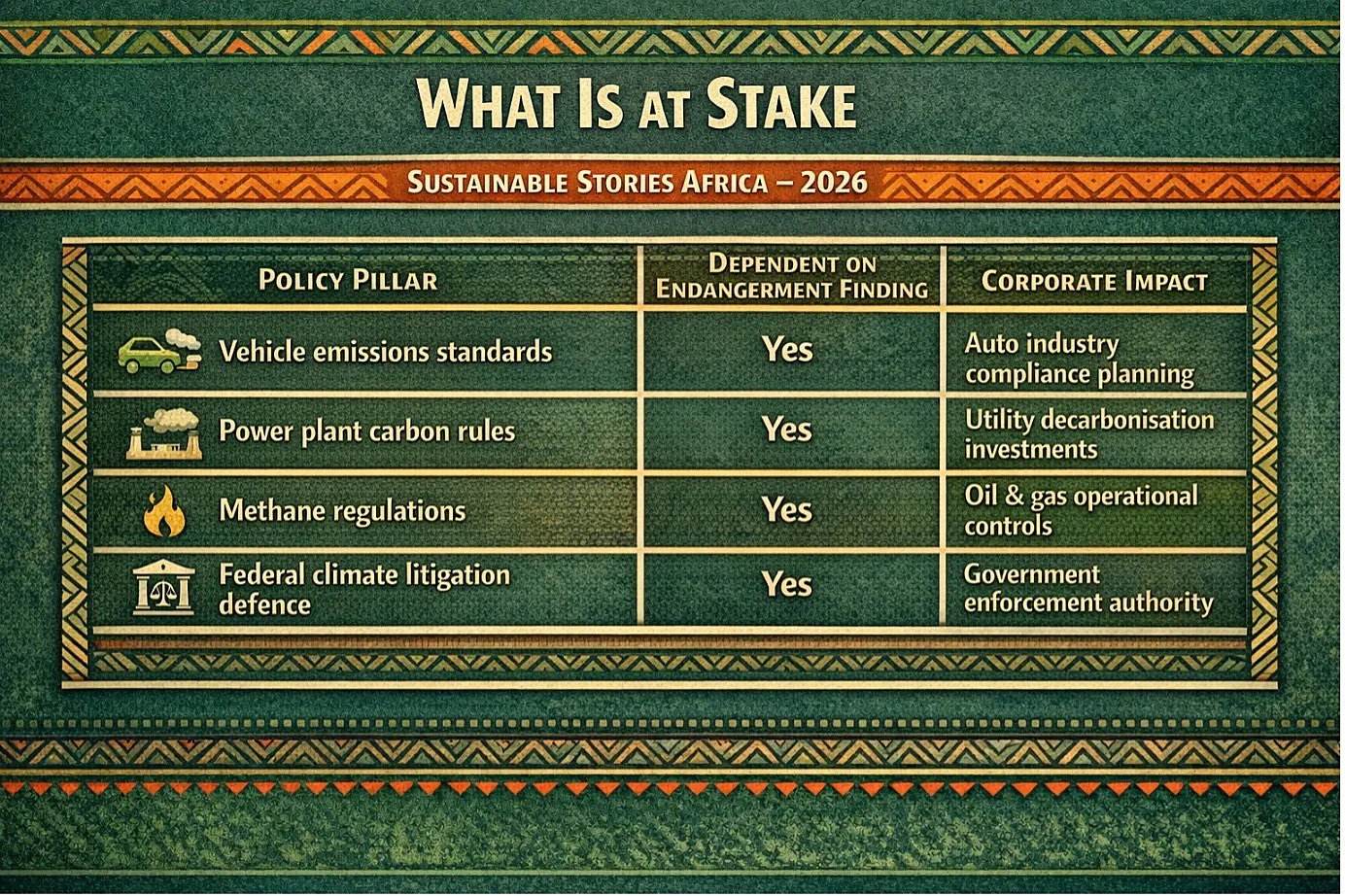
What Is at Stake
| Policy Pillar | Dependent on Endangerment Finding | Corporate Impact |
|---|---|---|
| Vehicle emissions standards | Yes | Auto industry compliance planning |
| Power plant carbon rules | Yes | Utility decarbonisation investments |
| Methane regulations | Yes | Oil & gas operational controls |
| Federal climate litigation defence | Yes | Government enforcement authority |
Courts Become Climate Arena
The case now moves into federal litigation, where courts will examine whether the EPA’s reconsideration aligns with administrative law standards and scientific evidence requirements.
Environmental advocates argue that the challenge is essential to preserving science-based governance. “Climate policy cannot be erased by administrative fiat,” one legal observer noted.
Corporate counsel teams are preparing scenario analyses. Some firms anticipate regulatory rollback; others warn that state-level climate policies could fill any federal vacuum, creating a patchwork compliance landscape.
If courts uphold the endangerment finding, federal climate authority remains intact. If overturned, Congress may face renewed pressure to legislate explicit climate mandates.
Path Forward – Legal Clarity, Scientific Integrity Required
The immediate priority is judicial clarity. Courts must determine whether established scientific findings can be overturned without the presentation of any substantive new evidence.
In the long term, durable climate governance may require legislative reinforcement.
Investors, regulators and corporations alike seek predictable rules anchored in transparent science, ensuring policy continuity beyond electoral cycles.
Culled From: https://www.esgdive.com/news/epa-sued-over-rescission-of-endangerment-finding/812709/