
ESG is no longer a corporate side note.
Across industries, environmental, social, and governance level metrics are being embedded into capital allocation, risk management and long-term strategy.
Executives say best practice has shifted from disclosure compliance to operational transformation, redefining how companies measure success.
ESG Best Practices Transform Corporate Strategy
Corporate ESG strategy is undergoing a structural shift. What began as voluntary sustainability reporting has evolved into a central pillar of competitive positioning, investor confidence and regulatory alignment.
Boards are now integrating ESG criteria into enterprise risk frameworks, executive compensation structures and supply chain oversight.
Investors, meanwhile, are increasingly assessing companies not only on financial returns but also on their resilience, transparency and climate preparedness.
Industry observers describe the transition as a move from “ESG as narrative” to “ESG as operating model.”
From Reporting to Strategy
In recent years, global reporting frameworks, such as IFRS sustainability standards and climate disclosure guidelines, have standardised ESG transparency expectations. But best practice now extends beyond disclosure.
Companies are embedding ESG considerations into:
- Capital expenditure decisions
- Product design and lifecycle management
- Human capital development strategies
- Governance oversight mechanisms
Regulators in multiple jurisdictions are tightening climate and sustainability reporting mandates, raising the cost of weak governance.
Integration Drives Competitive Advantage
Leading firms are reframing ESG as a source of operational efficiency and market differentiation. Energy efficiency reduces cost exposure, supply chain transparency mitigates disruption risk, and diversity and governance reforms strengthen institutional credibility.
Strategic ESG integration typically includes:
- Materiality assessments aligned with enterprise risk
- Data-driven performance metrics
- Board-level sustainability committees
- Clear linkage between ESG KPIs and executive incentives
Rather than treating sustainability as a compliance burden, high-performing firms use it to unlock innovation, developing low-carbon products, circular supply chains and resilient infrastructure.
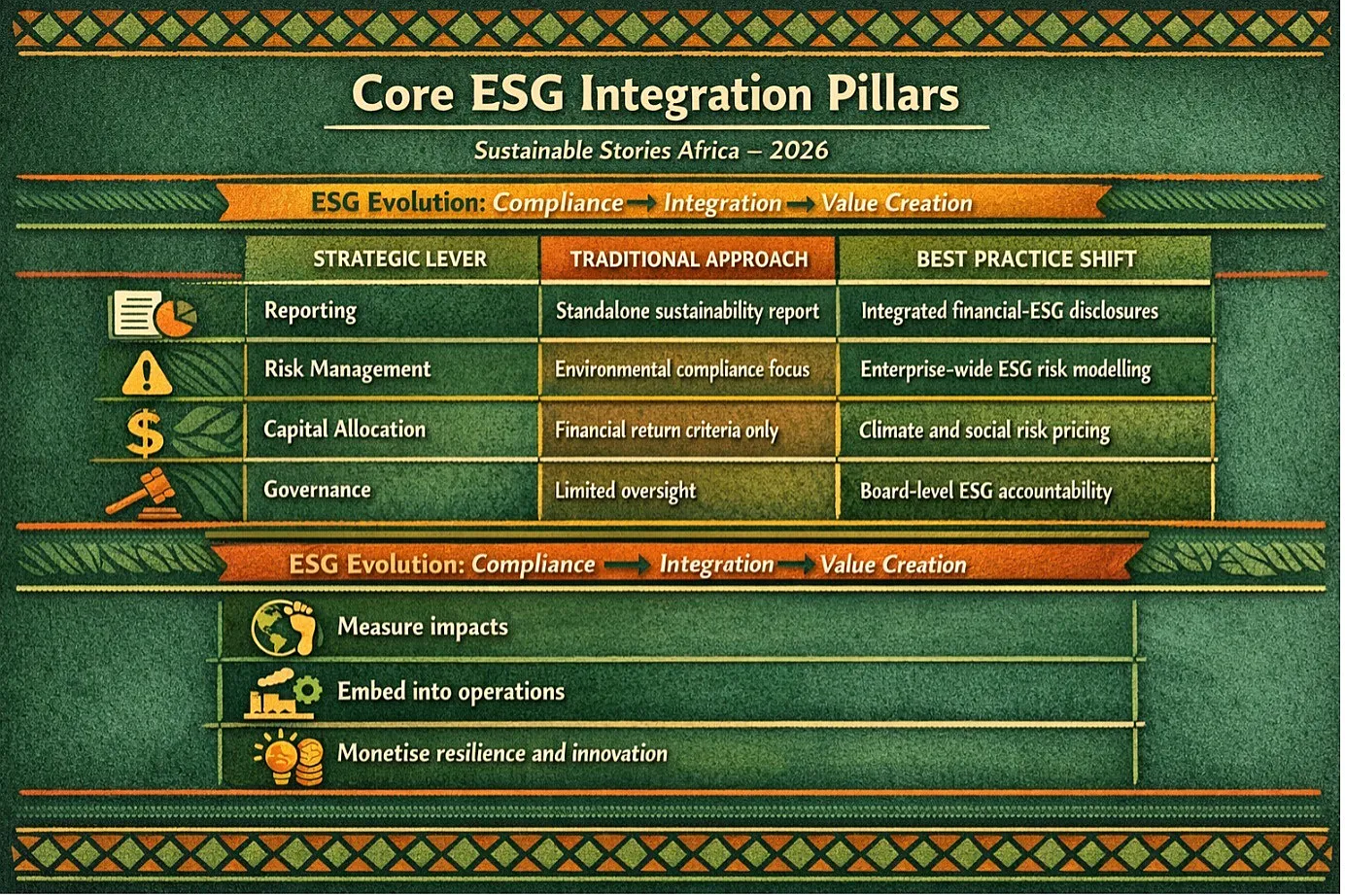
Core ESG Integration Pillars
| Strategic Lever | Traditional Approach | Best Practice Shift |
|---|---|---|
| Reporting | Standalone sustainability report | Integrated financial-ESG disclosures |
| Risk Management | Environmental compliance focus | Enterprise-wide ESG risk modelling |
| Capital Allocation | Financial return criteria only | Climate and social risk pricing |
| Governance | Limited oversight | Board-level ESG accountability |
Institutionalise ESG Discipline
Analysts argue that effective ESG transformation requires internal discipline. Data systems must be robust, emissions baselines must be verified, and governance roles must be clearly defined.
Companies are increasingly investing in digital ESG platforms to track real-time performance metrics. External assurance and transparent reporting enhance stakeholder trust.
The strategic payoff is measurable. Firms with integrated ESG strategies often demonstrate stronger risk-adjusted returns and improved access to capital, particularly as sustainable finance markets expand.
However, credibility remains fragile. Greenwashing allegations can rapidly erode brand value. Best practice, therefore, demands consistency between public commitments and operational evidence.
Path Forward – Embed ESG Into Core Governance
Corporate leaders must institutionalise ESG within their strategy, not communications. Aligning capital allocation, risk modelling, and executive incentives with sustainability targets is essential.
Transparent data, independent assurance, and board accountability will define durable ESG leadership, transforming sustainability from obligation into a long-term value driver.
Culled From: ESG Best Practices: Transforming Corporate Strategy for Sustainable Success