Africa’s disaster burden is no longer episodic; it is structural. Over the past decade, the continent has become the only region globally where disaster incidence is rising relative to global totals, becoming a threat to economic stability, public health, and long-term development.
However, the African Union’s disaster risk strategy signals a critical shift, from reacting to crises to preventing them.
The challenge now is execution: embedding disaster resilience into fiscal planning, governance, infrastructure, and public awareness before shocks erase years of economic progress.
Rising Disasters Threaten Africa’s Development Gains
Africa’s development trajectory is increasingly shaped not only by economic policy or capital investment, but by disaster risk.
Floods, droughts, epidemics, and climate-driven hazards have become persistent structural threats to national stability and growth. The continent now stands at a critical inflexion point where disaster risk management is inseparable from development planning.
The Africa Regional Strategy for Disaster Risk Reduction, adopted by African Union ministers, reflects recognition that disasters are no longer isolated humanitarian emergencies; they are systemic economic risks capable of reversing national growth.
The strategy marks a fundamental shift in policy thinking: disasters must be prevented and mitigated through the integration of governance, finance, and development, rather than being responded to after the damage is done.
Africa’s Rising Disaster Risks Demand Structural Transformation
Africa is now the only continent where the proportion of global disasters is rising, with impacts increasingly undermining sustainable development and poverty reduction efforts.
The scale of vulnerability is staggering.
Between 2000 and 2001 alone, disasters affected approximately 35 million people, 13% of Africa’s population, highlighting the continent’s structural exposure to environmental and health shocks.
Economic consequences have been equally severe. Mozambique’s 2000 floods reduced GDP by 12%, while droughts in Zimbabwe and Zambia cut national output by roughly 9%, demonstrating that disasters can erase years of economic progress almost overnight.
These are not isolated events; they represent systemic economic vulnerabilities.
Weak Governance And Financing Deepen Vulnerability Crisis
Africa’s disaster risk challenge is not merely environmental; it is institutional.
The strategy’s baseline study identified critical structural gaps:
Structural Gap | Impact on Resilience |
|---|---|
Weak institutional frameworks | Fragmented disaster risk management capacity |
Limited risk identification systems | Inadequate early warning and hazard mapping |
Poor knowledge management | Weak data, research, and communication systems |
Governance deficiencies | Weak coordination and enforcement |
Limited financing mechanisms | Insufficient funding and insurance coverage |
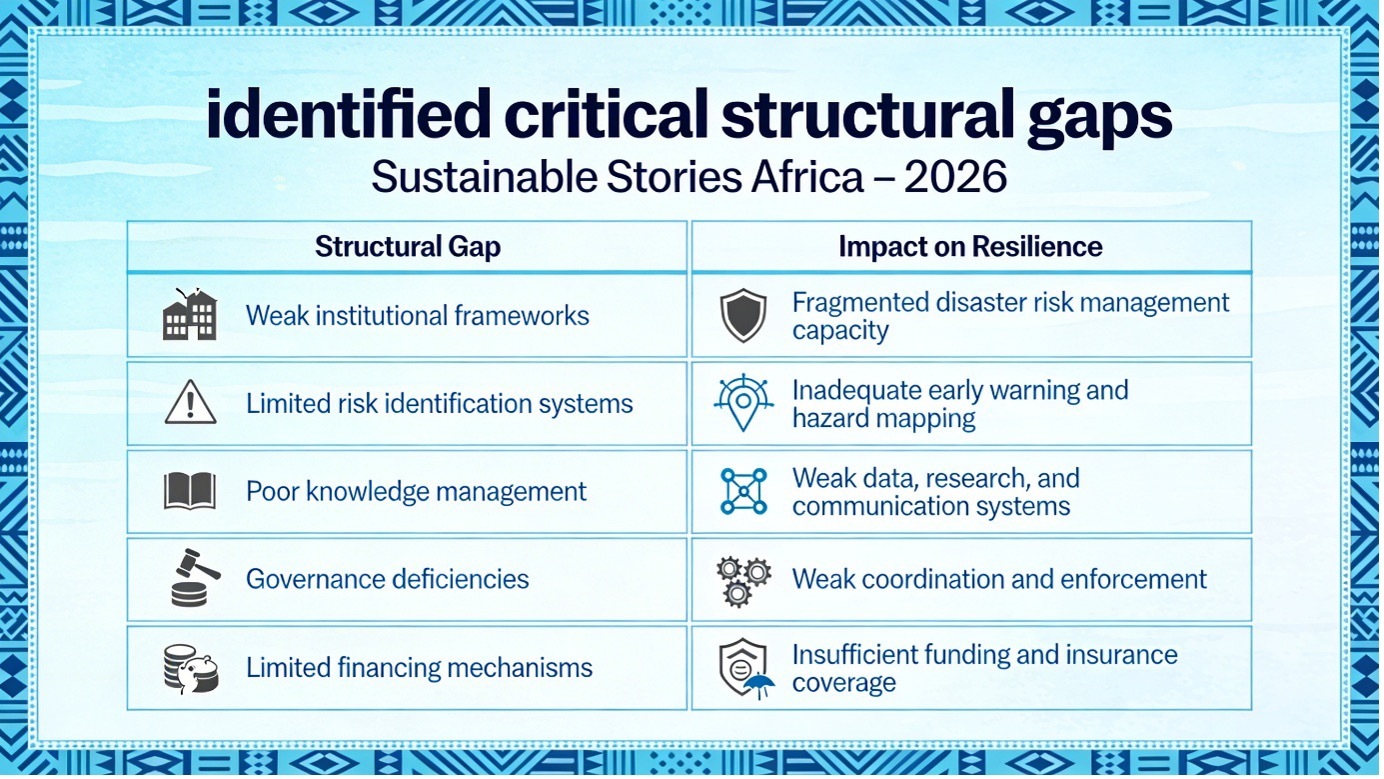
These gaps have allowed disaster risk exposure to grow faster than institutional capacity to prevent it.
National disaster management systems often lack sufficient funding, with many dependent on development partners rather than domestic fiscal allocations.
Risk identification remains inadequate, with many countries emphasising post-disaster response rather than prevention. Early warning systems exist but are fragmented, underfunded, and insufficiently integrated into development planning.
At the same time, public awareness remains limited, in part because disaster risk communication systems are weak and disaster risk education is rarely integrated into national curricula.
This governance gap has turned disaster risk into a silent economic threat.
Strategic Integration Offers Pathway To Economic Stability
The Africa Regional Strategy signals a structural shift, from emergency response to systemic prevention.
Its core objective is clear: integrate disaster risk reduction into national development frameworks, safeguarding economic growth, infrastructure, and human capital.
Key strategic priorities include:
Strategic Priority | Expected Development Impact |
|---|---|
Political commitment and dedicated funding | Stronger institutional capacity and resilience |
Improved risk identification and early warning | Reduced disaster losses and faster response |
Knowledge management and public awareness | More informed decision-making and preparedness |
Governance reforms and decentralisation | Stronger coordination and accountability |
Integration into development planning | Sustainable infrastructure and economic resilience |
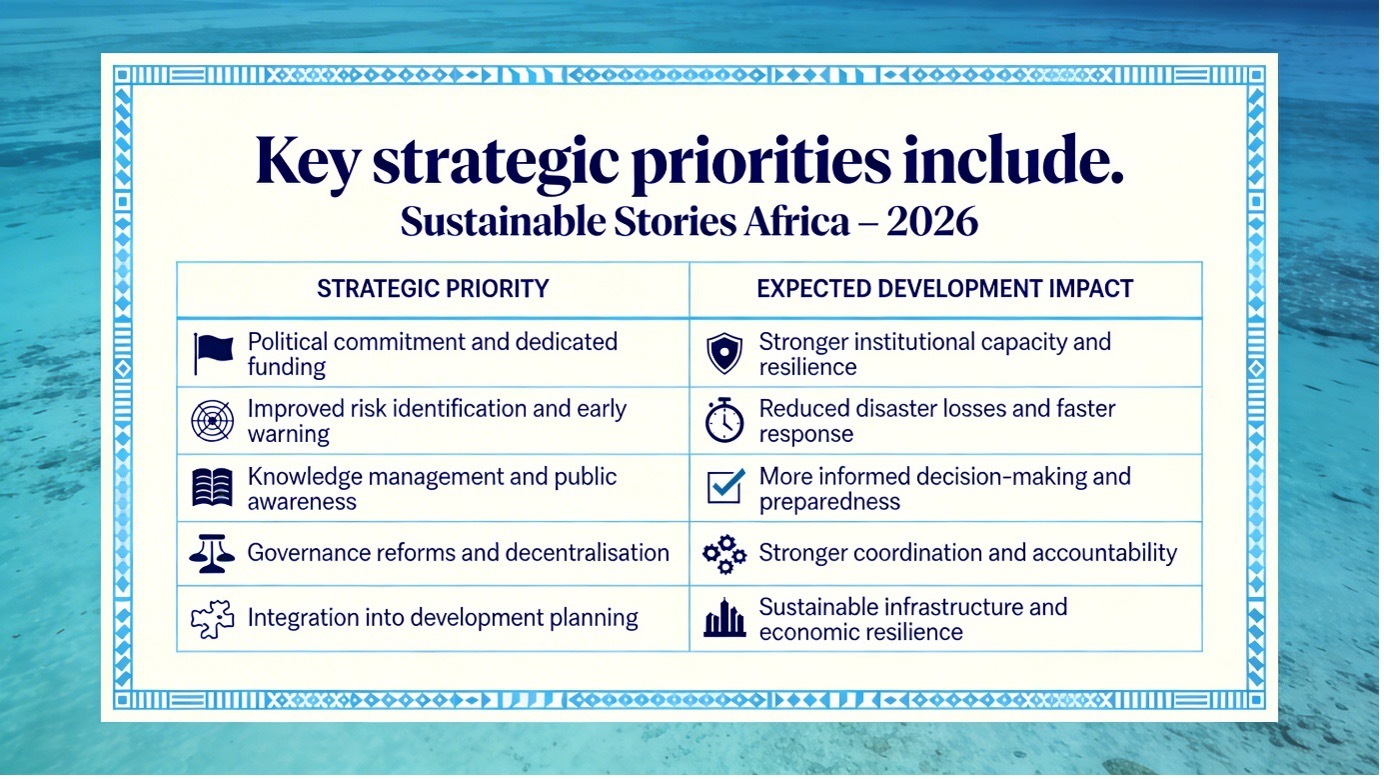
This approach fundamentally repositions disaster risk reduction as an economic development strategy, not merely a humanitarian function.
Critically, the strategy encourages governments to allocate dedicated funding and integrate disaster risk considerations into national fiscal and development frameworks.
It also emphasises the importance of insurance, microfinance, and private sector investment to expand resilience financing mechanisms.
These reforms could transform disaster resilience from a reactive cost into a proactive investment.
Resilience Investment Must Become Economic Policy Priority
Africa’s disaster risk trajectory is now inseparably intertwined with its economic future.
Without structural reform, disasters will continue to undermine infrastructure, reduce productivity, and weaken fiscal stability.
But the strategy outlines a clear pathway forward.
Governments must:
- Integrate disaster risk into infrastructure and fiscal planning
- Strengthen early warning systems and risk monitoring
- Invest in institutional capacity and disaster resilience funding
- Improve governance coordination across national and regional levels
- Mobilise private sector participation in resilience financing
The private sector, development partners, and civil society must also play active roles.
Disaster resilience is no longer optional; it is essential to safeguarding Africa’s economic transformation.
PATH FORWARD – Institutional Reform And Investment Drive Resilience
Africa’s disaster risk strategy prioritises institutional reform, governance strengthening, and integration of resilience into development planning.
Governments, private sector actors, and development partners must coordinate investments in early warning systems, infrastructure resilience, and disaster risk financing mechanisms.
Embedding disaster risk reduction into fiscal policy, infrastructure development, and economic planning will help protect national growth, stabilise economies, and safeguard Africa’s long-term sustainable development trajectory.