Africa's transport challenge is no longer about vehicles alone. It is about power systems, jobs, public health and whether climate ambition can align with everyday mobility.
IRENA's 2025 policy review on renewables-based road transport electrification makes one message unavoidable: without systemic reform, electrification will stall where it is needed most.
From two-wheelers to freight corridors, the transition now hinges on institutions, delivery capacity and political clarity and will, not technology scarcity.
Electrifying Roads, Rewiring Development Outcomes
Africa's road transport system sits at the intersection of growth and risk. It moves people to jobs, goods to markets, and economies forward. However, it is also one of the continent's fastest-growing sources of emissions, air pollution and import dependence.
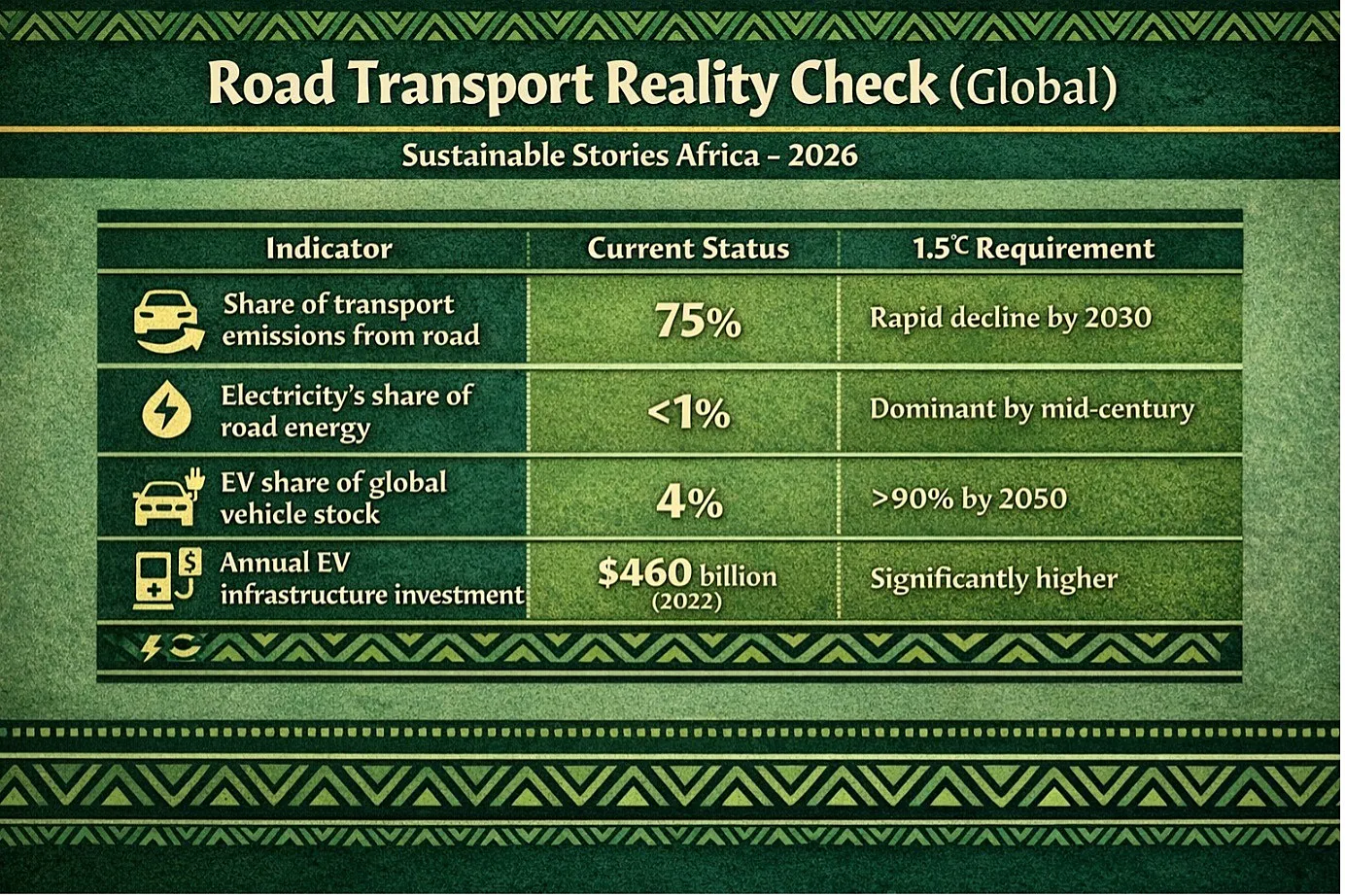
According to IRENA, road transport accounts for roughly 75% of global transport emissions, whilst electricity still represents less than 1% of its energy use, despite electric vehicles being two to four times more energy-efficient than internal combustion engines.
This mismatch defines the policy moment. Electrification is no longer a climate aspiration; it is an economic necessity. Without it, rising urbanisation, freight demand and population growth will lock African economies into higher fuel costs, deteriorating air quality and stranded infrastructure.
IRENA's 2025 report reframes the transition as a governance and delivery challenge. The question is no longer whether electrification works, but how quickly institutions can align power, transport and industrial policies to make it inclusive, affordable and renewable-based.
Transport Electrification Is Now Economic Policy
The electrification of road transport has quietly become one of the most consequential economic policy choices facing African governments.
IRENA's analysis shows that meeting a 1.5°C pathway requires an eight-fold increase in global EV stock by 2030 and annual investments exceeding $300 billion in charging infrastructure alone.
For Africa, this is not about catching up with Europe or China. It is about leapfrogging a fossil-locked mobility system that is already straining fiscal balances and urban health systems.
Diesel buses and trucks, which make up less than 5% of vehicle fleets, generate over 60% of road-based particulate pollution, thereby imposing direct healthcare and productivity costs.
Electrification, when powered by renewables, offers an efficiency dividend that compounds across energy security, jobs and air quality.
Where Policy Meets Real-World Constraints
IRENA identifies five cross-cutting barriers essential to electrification in emerging and developing markets: "institutional fragmentation, market dominance of ICE vehicles, high upfront costs, inadequate charging infrastructure, and weak public awareness."
These barriers manifest differently across vehicle segments:
- Two and three-wheelers present the fastest electrification opportunity, particularly for African cities reliant on informal mobility and last-mile logistics. Local assembly and battery-swapping models lower entry barriers and create domestic value chains.
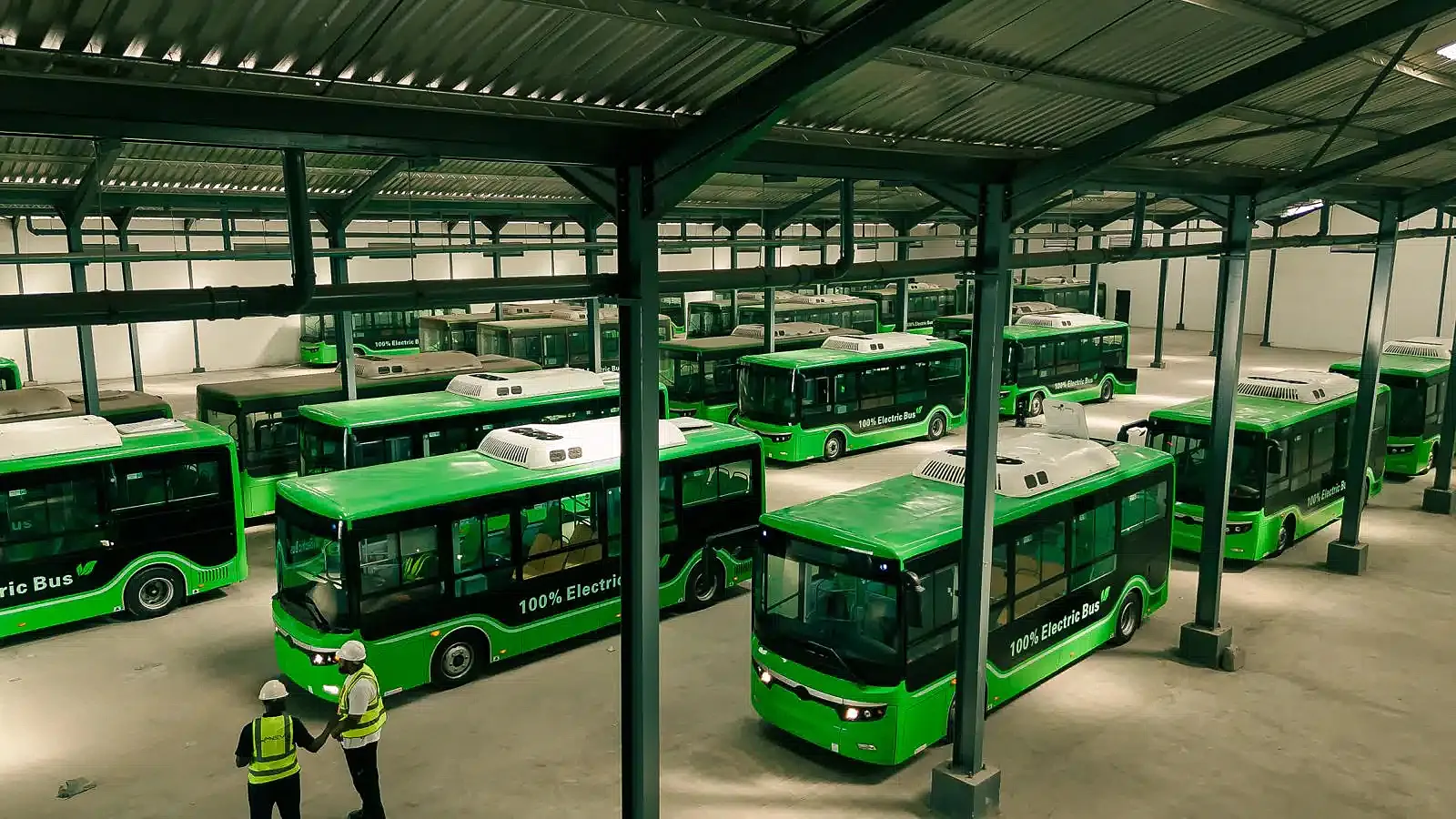
- Electric buses deliver the highest equity returns, replacing up to 30 private cars per bus while improving access to jobs and education. Yet procurement and financing models remain a hindrance, due to their higher upfront costs.
- Freight trucks represent the hardest challenge. While battery-electric trucks are viable for short-haul corridors, long-distance freight requires policy-led charging corridors, zero-emission targets and demand aggregation.
IRENA's key insight is that technology readiness now outpaces institutional readiness. Without integrated planning among energy regulators, transport authorities, and cities, electrification risks remaining a perpetual pilot-project story.
Road Transport Reality Check (Global)
| Indicator | Current Status | 1.5°C Requirement |
|---|---|---|
| Share of transport emissions from road | 75% | Rapid decline by 2030 |
| Electricity's share of road energy | <1% | Dominant by mid-century |
| EV share of global vehicle stock | 4% | >90% by 2050 |
| Annual EV infrastructure investment | $460billion (2022) | Significantly higher |
Why Electrification Delivers More Than Climate Gains
The strongest case for electrifying Africa's road transport is not carbon, it is development impact.
IRENA documents three decisive co-benefits:
- Jobs and Industrialisation – Electric two and three-wheelers, buses and charging systems enable local manufacturing, assembly and maintenance ecosystems. Boxed case studies have shown that decentralised EV value chains create direct, indirect and induced employment.
- Health and Urban Productivity – Electrification sharply reduces NOx and particulate matter emissions, especially from diesel fleets. Where cities adopt low-emission zones and electric public transport, they record immediate air-quality gains.
- Energy System Efficiency – Smart charging, vehicle-to-grid services and solar-EV integration allow transport electrification to stabilise, not strain power systems. EVs become flexible demand assets rather than grid liabilities.
IRENA stresses that just transition policies, such as reskilling workers, affordable EV access and inclusive planning, determine whether these benefits reach low-income communities or remain concentrated.
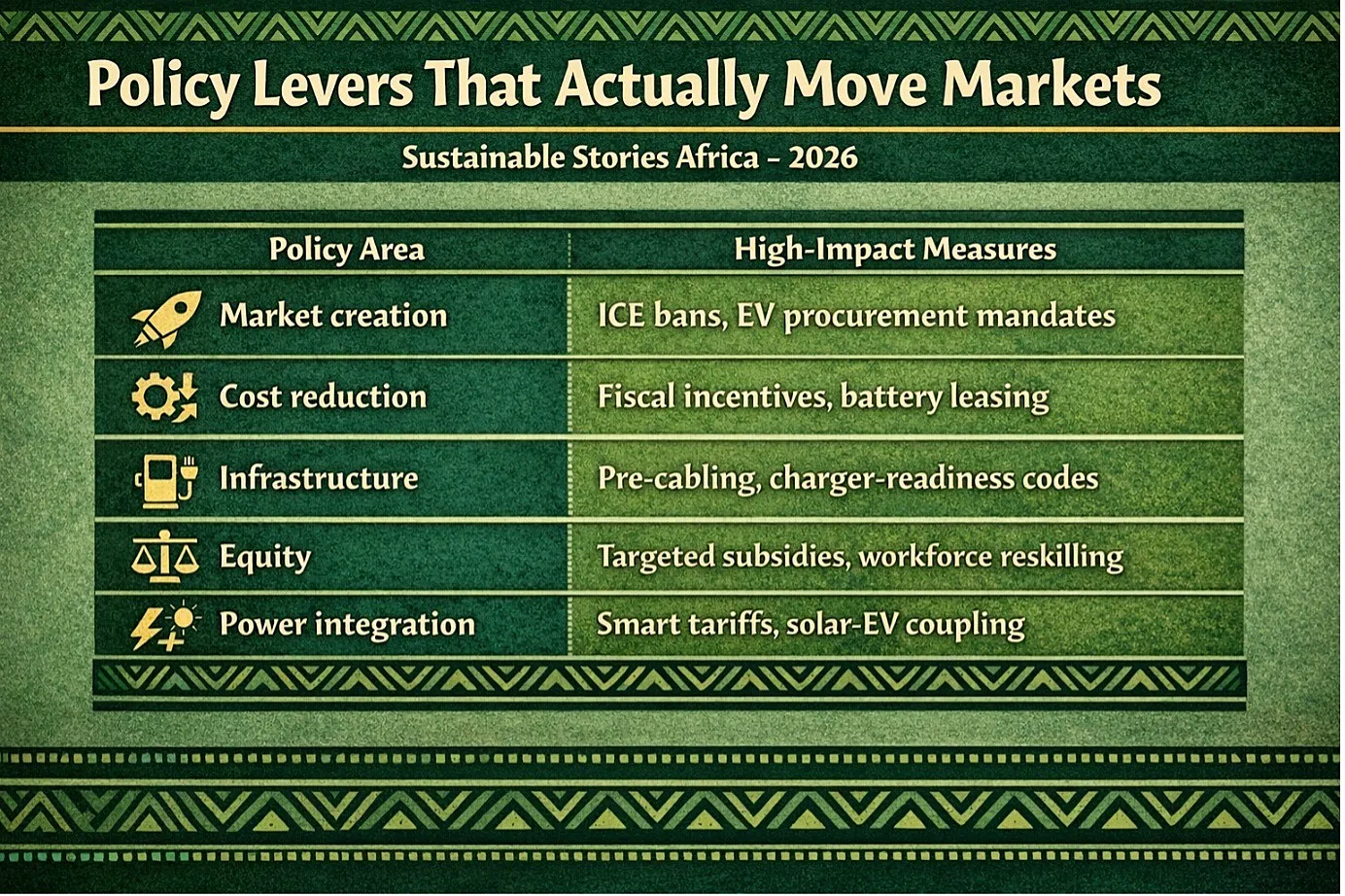
Policy Levers That Actually Move Markets
| Policy Area | High-Impact Measures |
|---|---|
| Market creation | ICE bans, EV procurement mandates |
| Cost reduction | Fiscal incentives, battery leasing |
| Infrastructure | Pre-cabling, charger-readiness codes |
| Equity | Targeted subsidies, workforce reskilling |
| Power integration | Smart tariffs, solar-EV coupling |
What African Policymakers Must Do Now
IRENA's policy roadmap is explicit: delay is costlier than action.
African governments must prioritise:
- Clear national EV targets aligned with renewable power expansion
- City-led electrification strategies covering buses, taxis and two-wheelers
- Blended finance models to crowd in private capital for charging corridors
- Institutional coordination between energy, transport and urban authorities
Without these steps, electrification will remain fragmented, failing to scale where demand is growing fastest.
PATH FORWARD – Electrify Mobility, Deliver Development Outcomes
The renewables-based electrification of road transport is now a test for African governance. IRENA's evidence shows that technology is ready; institutions must catch up.
Integrated planning, just transition safeguards, and smart power-transport alignment will determine success.
The opportunity is clear: cleaner cities, stronger industries and resilient energy systems, if policy moves with urgency.