Africa's development challenge is no longer about vision—it is about delivery. As global uncertainty deepens, Foresight Africa 2025–2030 argues that governance quality, digital trust, and global partnerships will determine whether growth translates into lived prosperity.
Five Years To Make Government Matter
Africa's growth prospects have improved, but citizens' lived experiences often have not. Elections are more frequent, policies are more ambitious, and technologies are more advanced; however, trust in institutions remains fragile, public services are uneven, and persistent economic insecurity.
Pages 78–105 of Foresight Africa 2025–2030 shift the focus from economics to systems of power: how governments govern, how technologies are deployed, and how Africa engages the world.
The report's underlying message is clear: without effective governance, emerging technologies and global partnerships will amplify inequality rather than reduce it.
With the 2030 deadline approaching, these chapters argue that Africa's next phase will be defined less by ambition and more by institutional performance.
Governance Is Africa's Binding Constraint
Across the continent, the gap between policy intent and policy outcome remains wide. While many African governments have adopted reforms aligned with the SDGs and Agenda 2063, implementation lags, especially at local levels.
Survey evidence and case studies in Foresight Africa highlight that weak accountability, limited rule-of-law enforcement, and poor service delivery continue to erode public trust.
This governance deficit is not abstract: it shapes job creation, social stability, debt sustainability, and citizens' willingness to comply with reforms.
The report warns that countries unable to translate policy into tangible outcomes face rising fragility, even when headline growth looks strong.
Why Institutions Matter More Than Ever
- Governance and service delivery – Effective governance is framed not as ideology, but as capacity: budgeting systems that work, procurement that delivers, courts that enforce contracts, and local governments empowered to act.The report highlights that where citizens see improvements in education, health, security, and infrastructure, trust rebounds. Where they do not, democratic legitimacy weakens, fueling instability and policy reversals.
- Fragility, jobs, and democracy – High unemployment, especially among youth, interacts dangerously with weak institutions.Several viewpoints stress that job creation is the most effective anti-fragility strategy. Where states fail to deliver livelihoods, non-state actors fill the vacuum.
- Debt and democratic stress – Debt servicing now absorbs a growing share of public resources, crowding out social investment. The report draws a clear line between fiscal stress and democratic erosion: austerity without credibility undermines both growth and trust.
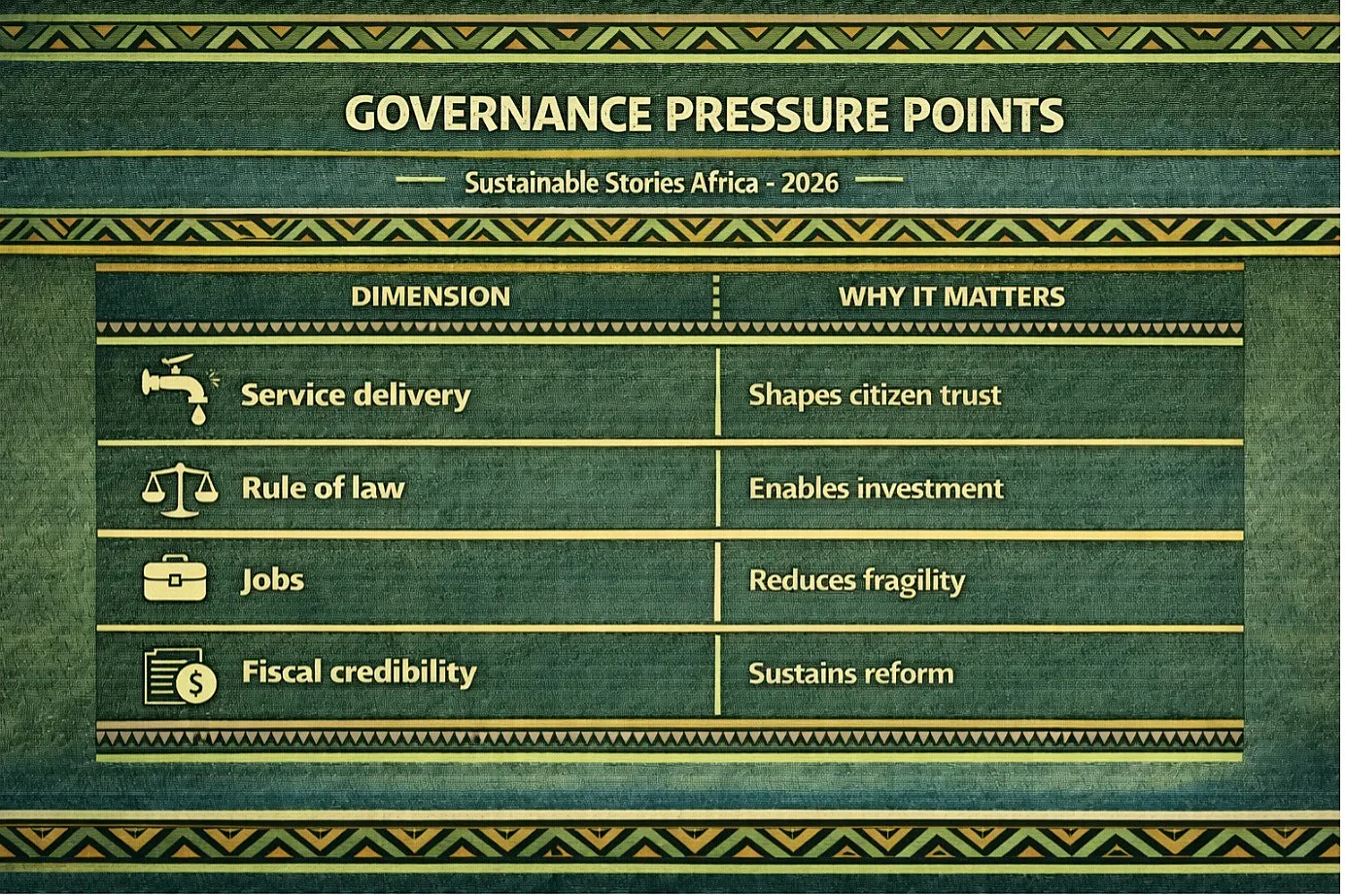
Governance Pressure Points
| Dimension | Why It Matters |
|---|---|
| Service delivery | Shapes citizen trust |
| Rule of law | Enables investment |
| Jobs | Reduces fragility |
| Fiscal credibility | Sustains reform |
Technology as Accelerator, Not Divider
Pages 90–100 turn to artificial intelligence and emerging technologies, not as silver bullets, but as force multipliers.
Africa is already a fast adopter: digital finance, agri-tech, and e-government platforms are transforming daily life. Properly governed, AI can expand access to services, improve tax collection, enhance health diagnostics, and support climate adaptation.
But the report is equally clear on the risks. Without inclusive digital infrastructure, skills development, and ethical governance, AI could deepen exclusion, entrench surveillance abuses, and widen inequality.
Digital trust, such as clear rules on data, transparency, and accountability, is identified as the new foundation of state legitimacy.
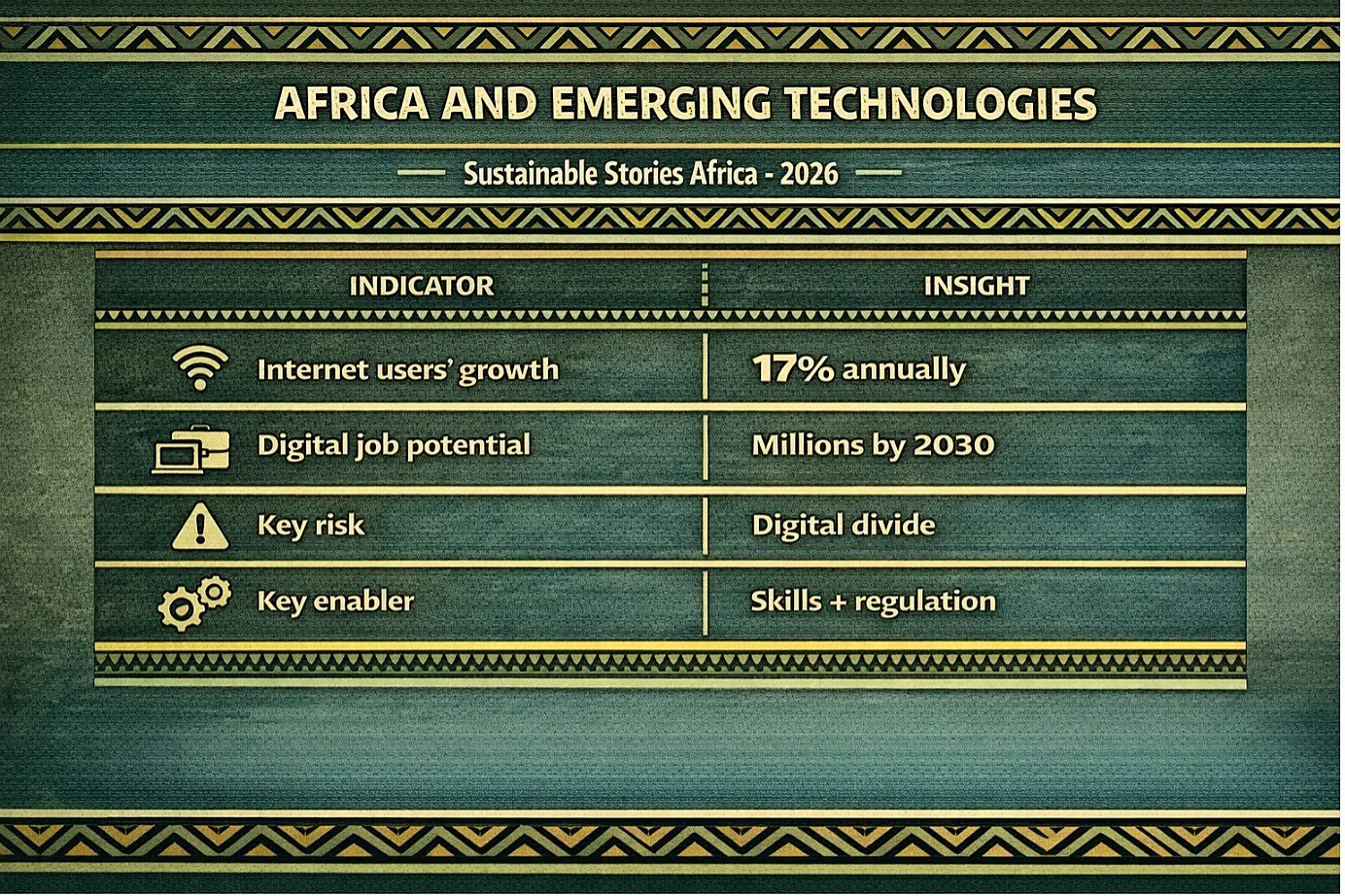
Africa and Emerging Technologies
| Indicator | Insight |
|---|---|
| Internet users' growth | 17% annually |
| Digital job potential | Millions by 2030 |
| Key risk | Digital divide |
| Key enabler | Skills + regulation |
Africa's Global Leverage Is Rising
The final section examines Africa's changing position on the global stage.
With permanent membership in the G20 and leadership roles in multilateral forums, Africa has more voice than at any point in recent history. But voice alone is insufficient. The report stresses that global partnerships must shift from extraction to co-creation, on trade, climate finance, technology, and security.
Africa's mineral endowment, strategic geography, and demographic weight give it leverage. The challenge is to use that leverage strategically, aligning external partnerships with domestic priorities rather than substituting for them.
Path Forward – Institutions First, Influence Follows
Africa's next five years hinge on institutional credibility. Effective governance, trusted digital systems, and strategic global partnerships can turn growth into resilience.
Without them, technology and geopolitics will magnify inequality. The choice is clear: build institutions that deliver, or risk squandering Africa's most consequential decade.