Apple has cut its greenhouse gas emissions by over 60% since 2015 while growing revenue by more than 65%. Its Environmental Progress Report 2025 reveals how design, supply-chain reform, clean energy, and circular materials are reshaping its carbon footprint.
For African companies under rising ESG scrutiny, Apple's model offers practical lessons on setting measurable targets, enforcing supplier standards, and aligning sustainability with business growth.
From Commitments To Measurable Climate Action
Apple's Environmental Progress Report 2025 presents a rare corporate narrative: deep emissions cuts alongside strong commercial growth.
Since 2015, the company has reduced its total greenhouse gas footprint by more than 60% across Scope 1, 2, and 3, while revenue has grown by over 65%. Its goal is to achieve full carbon neutrality across its entire value chain by 2030.
The strategy is defined around four pillars: clean electricity, low-carbon materials, decarbonisation of the supply chain, and high-quality carbon removal. Apple has powered all its corporate facilities with 100% renewable energy since 2018 and achieved carbon neutrality for its operations in 2020.
Suppliers now support 17.8 GW of clean energy, generating 31.3 million MWh annually.
For African companies navigating new ESG disclosure rules, climate risks, and investor expectations, Apple's approach offers a practical blueprint: measurable targets, transparent reporting, and strong supplier accountability systems.
Climate Action, Business Growth Aligned
Apple's climate strategy is not symbolic. In 2024 alone, its environmental programs avoided 41 million metric tonnes of CO₂e, while net emissions fell to 14.5 million metric tonnes.
Product manufacturing, product use, and logistics remain the largest sources of emissions; however, these are precisely where Apple has focused its interventions.
The company's flagship achievement: launching its first carbon-neutral Mac mini, made with over 50% recycled materials and produced using 100% renewable electricity. The product's carbon footprint is over 80% lower than a business-as-usual scenario.
For African firms, ESG leadership isn't written in policy; it's proven in products.
Systems, Targets, And Data Discipline
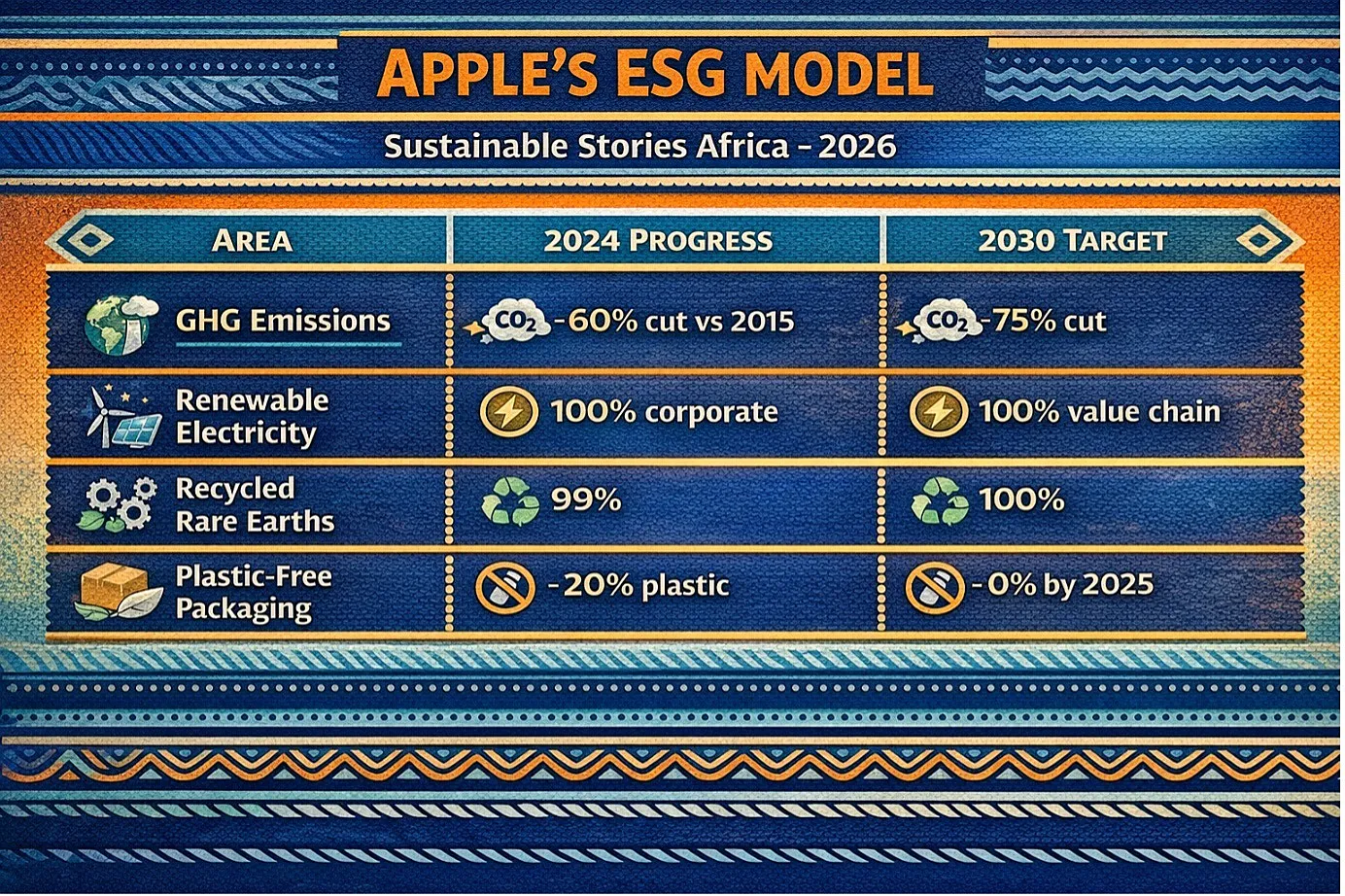
Apple's ESG model is built on clear, time-bound targets:
| Area | 2024 Progress | 2030 Target |
|---|---|---|
| GHG emissions | 60% cut vs 2015 | 75% cut |
| Renewable electricity | 100% corporate | 100% value chain |
| Recycled rare earths | 99% | 100% |
| Plastic-free packaging | 20% plastic | 0% by 2025 |
Key operational lessons for African companies:
- Supplier accountability – Apple requires its manufacturing suppliers to use 100% renewable electricity before 2030. Over 80 facilities now participate in its Supplier Energy Efficiency Program, saving 2.5 billion kWh and avoiding nearly 2 million tonnes of CO₂e in 2024 alone.
- Circular material strategy – In 2024, 24% of all materials shipped in Apple products came from recycled or renewable sources. Some components now use:
- 99% recycled rare earth elements
- 76% recycled cobalt
- 53% recycled lithium
- 71% recycled aluminium
- Transparent Carbon Accounting – Apple discloses its full value-chain emissions, including product use, logistics, and end-of-life processes — a level of transparency still rare in African corporate reporting.
Why This Matters For African Companies
Africa's ESG landscape is changing fast. Regulators, banks, and investors increasingly demand credible climate data, supply-chain accountability, and transition plans.
Apple's experience shows that:
- Strong ESG improves investor confidence – Oversubscribed green bonds and transparent disclosures attract capital.
- Operational efficiency cuts costs – Energy efficiency across facilities saved over 93,000 tonnes of CO₂e in 2024 alone.
- Sustainable design drives innovation – The Mac mini uses 85% less aluminium than its predecessor and consumes 79% less energy than ENERGY STAR requirements.
For Africa's manufacturers, utilities, banks, and telecoms, one thing is clear: ESG creates real change when it's built into products, supply chains, and everyday operations, not when it is confined to reports.
Practical Steps African Firms Can Take
- Set science-based targets – Apple aligns its emissions goals with a 1.5°C climate pathway. African firms should adopt similar benchmarks.
- Enforce supplier standards – Supplier codes of conduct should include renewable energy, water stewardship, and responsible sourcing.
- Invest in circular materials – Recycled metals, plastics, and packaging reduce both emissions and resource risk.
- Build ESG data systems – Apple tracks energy use every 15 minutes across facilities. African firms can begin by collating and collecting digital energy and water data and audits.
- Link ESG to products – Carbon-neutral or low-impact products strengthen both brand value and climate credibility.
PATH FORWARD – From Compliance To Climate Leadership
African companies can move beyond ESG compliance by embedding sustainability into operations, supply chains, and product design.
Apple's playbook proves that climate action isn't just good for the planet; it is smart for business, reducing risks, lowering costs, and fueling growth along the way.
By setting measurable targets, enforcing supplier standards, and reporting transparently, African firms can build ESG systems that attract capital, protect communities, and future-proof their businesses.