The World Urbanisation Prospects 2025 show a world where 45 per cent of people already live in cities and 36 per cent in towns, with almost all future population growth to mid‑century concentrated in urban areas.
However, the real action is in small and medium‑sized cities and fast‑growing towns, especially in Africa and Asia, where weak planning capacity, rapid land consumption and climate risk are colliding.
Seven countries alone will add over 500 million new city residents by 2050, even as the built‑up area per person rises and fertile farmland is paved over.
How these states manage urban growth, protect rural livelihoods and use better geospatial data could make or break the SDGs.
Cities will decide how Fair the future feels
For the first time in history, nearly half of the world's population lives in cities, and how those cities grow will shape the fate of the 2030 Agenda.
According to the United Nations' World Prospect 2025 report, in 2025, cities house 45% of the global population, while rural areas account for just 19%, a share that has halved since 1950.
However, urban growth is mostly in smaller cities: 96% of the world's 12,000 cities have fewer than one million residents, and 81% have under 250,000 people.
Geography will determine whether urbanisation reduces poverty or deepens vulnerability. Seven countries, India, Nigeria, Pakistan, the DRC, Egypt, Bangladesh and Ethiopia, will drive more than half of the projected rise in urban populations by 2050. Sub-Saharan Africa will absorb most of the rural population growth even as its towns expand rapidly, while developed regions face ageing and shrinking rural communities.
Urban expansion is also consuming land at an unsustainable pace. Built-up areas have grown almost twice as fast as the population since 1975, increasingly replacing farmland and increasing per-capita land use. Urbanisation now shapes not just where people live, but how much land, energy and carbon development consumes.
Urbanisation's quiet revolution in scale
City living has shifted from exception to norm. In 1950, just 20% of the world's 2.5 billion people lived in cities. By 2025, cities host 45% of the global population, towns 36%, and rural areas only 19%.
Looking ahead, cities will accommodate two-thirds of population growth by 2050, while the global rural population is projected to peak in the 2040s before declining.
Public attention, however, remains fixed on megacities. Their number has risen from eight in 1975 to 33 in 2025, mostly in Asia. Jakarta, Dhaka and Tokyo now top the rankings.
By 2050, Dhaka is expected to become the world's largest city, while several African and Asian cities are expected to have a population of 10 million residents.
However, the real growth story lies in smaller cities. Of 12,000 cities across the globe, 96% have a population of less than one million residents. Many of the fastest-growing are in sub-Saharan Africa and Central and Southern Asia, reshaping the future of urban development.
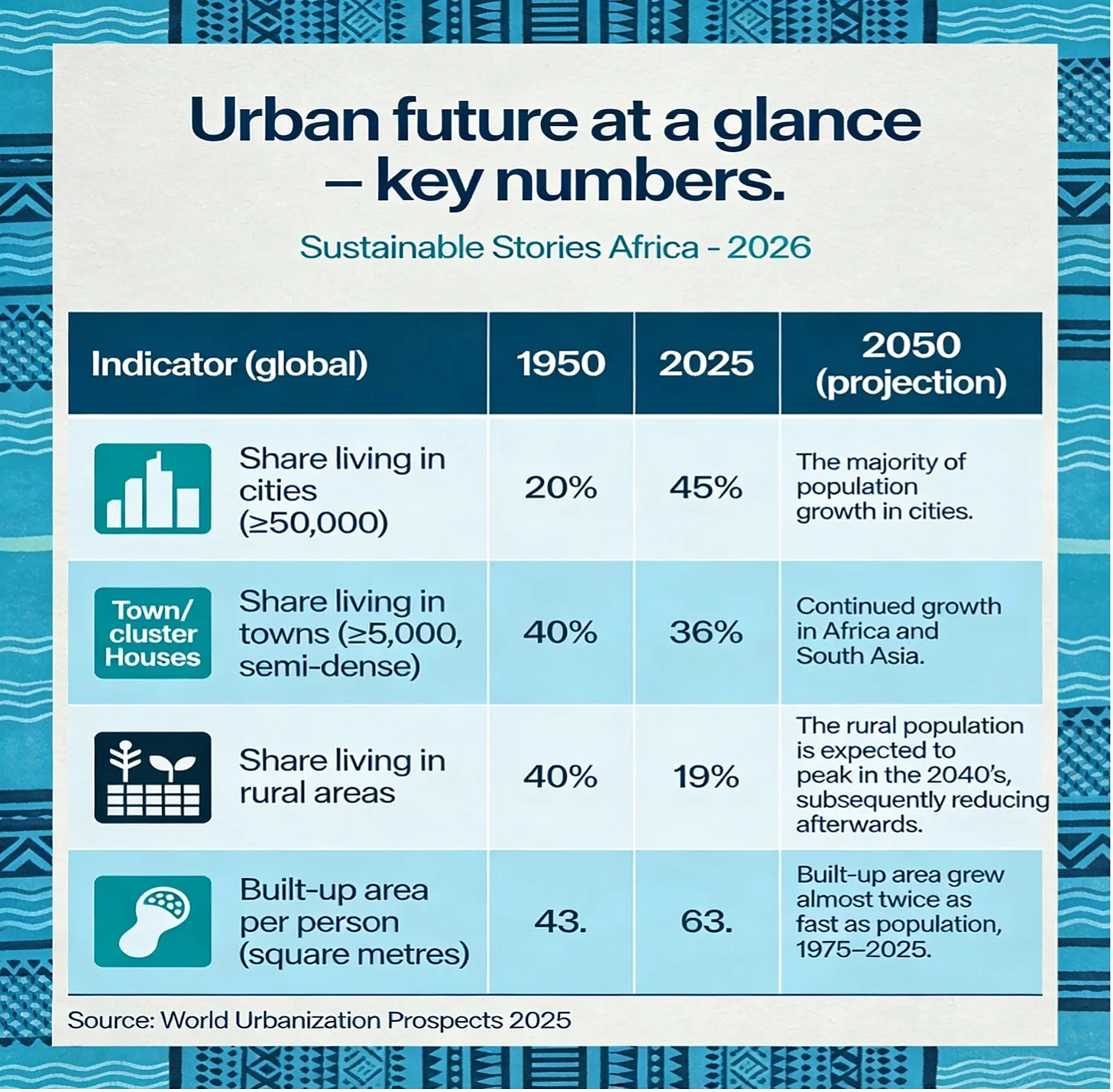
Urban future at a glance – key numbers
Indicator (global) | 1950 | 2025 | 2050 (projection) |
|---|---|---|---|
Share living in cities (≥50,000) | 20% | 45% | The majority of population growth in cities. |
Share living in towns (≥5,000, semi‑dense) | 40% | 36% | Continued growth in Africa and South Asia. |
Share living in rural areas | 40% | 19% | The rural population is expected to peak in the 2040’s, subsequently reducing afterwards. |
Built‑up area per person (square metres) | 43 | 63 | Built‑up area grew almost twice as fast as population, 1975–2025. |
Where growth, pressure and risk are converging
Between 2025 and 2050, India, Nigeria, Pakistan, the DRC, Egypt, Bangladesh and Ethiopia are expected to add over 500 million city residents. This is over 50% of global urban growth. How these countries manage expansion will shape progress on the SDGs and climate goals.
Urban change is also uneven within countries. More than 3,000 cities lost population between 2015 and 2025, mostly smaller towns.
Over one-third of shrinking cities are in China, with India accounting for another 17%. Even major cities such as Mexico City and Chengdu are beginning to contract, forcing planners to manage both growth and decline.
Towns sit at the centre of this transition. They remain the most common settlement type in 71 countries. India and China alone host over 1.2 billion town residents. In Africa and South Asia, populations of towns are rising quickly; however, investment, infrastructure and planning capacity often lag behind their growing importance.
Why rethinking "urban" could change everything
A quiet methodological shift underpins the 2025 World Urbanisation Prospects. For the first time, the report fully applies the harmonised "Degree of Urbanisation" framework, classifying every square kilometre into cities, towns or rural areas using consistent geospatial criteria.
This enables comparable analysis across 237 countries and more than 12,000 cities, while still allowing national definitions in the development of domestic policy.
The results suggest the world is more urban than official figures imply. While national statistics estimate that 58% of people live in urban areas in 2025, combining cities and towns under the new method shows a better reflection and produces a higher share. Many dense small towns, especially in Central and Southern Asia and sub-Saharan Africa, are still officially labelled rural, masking their true urban character.
This misclassification has real policy consequences. Areas deemed "rural" often miss out on urban infrastructure, climate planning and investment.
By pairing national and harmonised metrics, the report provides greater insights for governments, a clearer map for targeting services, land use and managing fast-growing settlements.
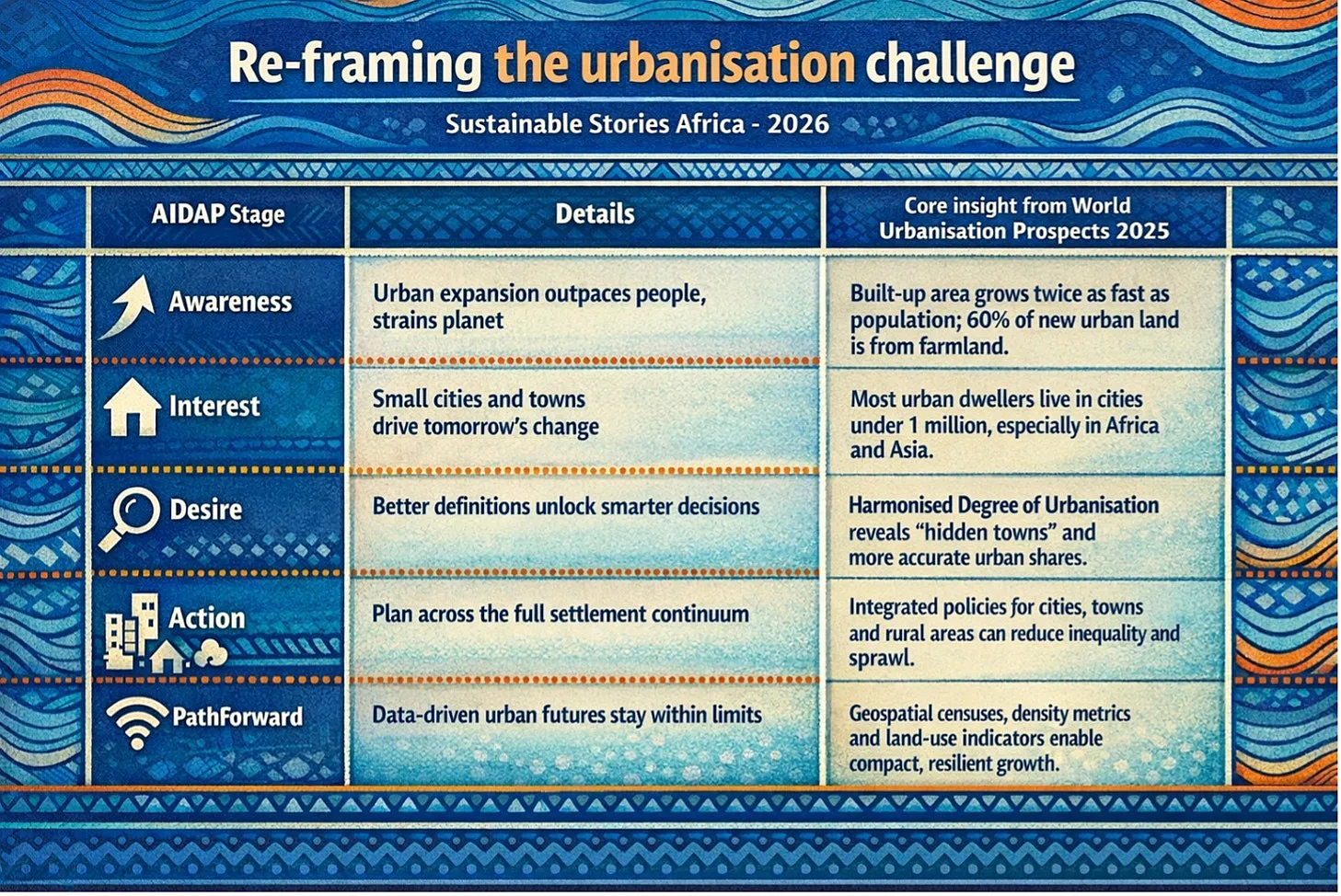
Re‑framing the urbanisation challenge
AIDAP stage | Details | Core insight from World Urbanisation Prospects 2025 |
|---|---|---|
Awareness | Urban expansion outpaces people, strains planet | Built‑up area grows twice as fast as population; 60% of new urban land is from farmland. |
Interest | Small cities and towns drive tomorrow’s change | Most urban dwellers live in cities under 1 million, especially in Africa and Asia. |
Desire | Better definitions unlock smarter decisions | Harmonised Degree of Urbanisation reveals “hidden towns” and more accurate urban shares. |
Action | Plan across the full settlement continuum | Integrated policies for cities, towns and rural areas can reduce inequality and sprawl. |
PathForward | Data‑driven urban futures stay within limits | Geospatial censuses, density metrics and land‑use indicators enable compact, resilient growth. |
Designing fairer, leaner, climate‑smart cities
The report calls for treating cities, towns and rural areas as one interconnected system. National urban policies should align housing, land use, transport and basic services across the settlement continuum to ease pressure on megacities, strengthen small towns and protect rural livelihoods.
Safeguarding fertile land such as black soils vital for global food production, from unchecked urban sprawl, is central to this approach.
At the city level, governments are urged to prioritise compact, well-planned growth over uncontrolled expansion.
Dense, connected cities can cut energy use and emissions through public transport and walkable design, while investing in climate-resilient infrastructure.
Rapidly growing cities need inclusive slum upgrading, not displacement, while ageing cities must adapt housing and public spaces for older populations.
Path Forward – Planning people, land, climate together now
A stronger data agenda is essential. Geo-referenced censuses, combined with satellite tools such as the Global Human Settlement Layer and WorldPop, can help countries track urban expansion, density, informal settlements and service access with greater precision.
Using Degree-of-Urbanisation metrics alongside national definitions improves how we measure and compare growth.
Monitoring indicators such as built-up area per person and urban fragmentation shows whether cities are becoming more efficient and inclusive, or more land-hungry, carbon-intensive and unequal.
For the SDGs and the New Urban Agenda, that distinction will shape whether urbanisation deepens the crisis or helps manage it.