Africa's development debate often circles capital, commodities, and geopolitics. But Foresight Africa 2025–2030 argues that the continent's most decisive growth lever lies closer to home: women, youth, and the systems that support their productivity.
From education reform and job creation to care infrastructure and entrepreneurship, the report reframes demographic inclusion not as social policy, but as macroeconomic strategy with five years left to deliver results.
Turning Demographics Into Economic Power
Africa is on the cusp of a demographic transformation unmatched in scale or speed. By 2030, one in five people across the globe will be Africans, the majority of them young and increasingly urban.
However, this demographic weight remains under-converted into broad-based prosperity.
Pages 136–167 of Foresight Africa 2025–2030 focus on the hard truth: demographics alone do not deliver growth.
Without deliberate investment in women, youth, and care systems, population growth risks deepening unemployment, informality, and inequality instead of fuelling productivity.
The report's central argument is clear. Africa's next five years will be defined by whether governments and markets treat women and youth as residual beneficiaries or as the core drivers of economic transformation.
Africa's Demographic Window Is Narrowing
Over 800 million people who will make up the global workforce by 2050 are going to be Africans, while other regions age rapidly. This should be a historic advantage.
Instead, youth unemployment remains persistently high, education outcomes are below expected levels, labour-market needs are unmet, and women's economic participation is constrained by legal, financial, and care burdens.
The report warns that failing to act decisively before 2030 would turn Africa's demographic promise into a fiscal and social strain.
Jobless growth, fragile states, and rising inequality are not abstract risks; they are already visible in many countries.
In this context, inclusion is not a moral add-on. It is the binding constraint on growth.
Why Women and Youth Matter Economically
- Women: the productivity gap – Women account for a large share of Africa’s informal workforce yet face structural barriers to land, credit, inheritance, and leadership. Foresight Africa highlights that closing gender gaps in labour participation and productivity could unlock trillions of dollars in economic value over time.
Crucially, unpaid care work remains invisible in economic planning. Women shoulder the bulk of childcare, eldercare, and water and fuel collection, limiting time available for paid work or entrepreneurship. The report identifies care systems as economic infrastructure, not social spending.
- Youth: aspiration versus opportunity – Africa’s youth are more educated and connected than any previous generation, yet job creation has not kept pace. The mismatch between schooling and labour-market needs leaves millions underemployed or excluded.
Several viewpoints stress that job creation, not social transfers are the most powerful stabiliser. Where youth see credible pathways to work and dignity, fragility recedes. Where they do not, migration pressures and instability rise.
- Education systems under strain – The report argues that many African education systems remain poorly aligned with the demands of a digital, services-oriented economy.
Reforming curricula, investing in vocational and digital skills, and partnering with the private sector are presented as urgent priorities.
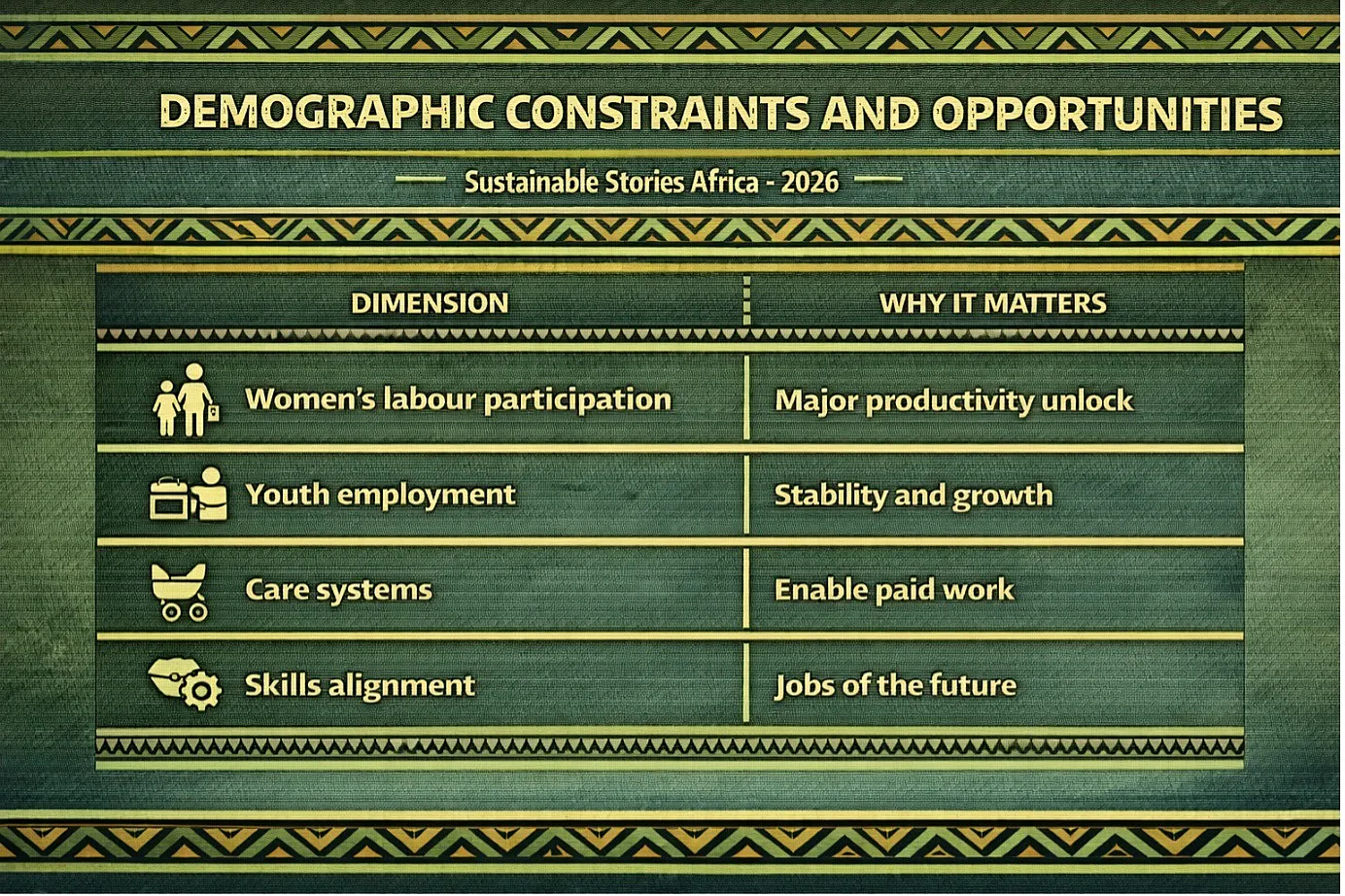
Demographic Constraints and Opportunities
| Dimension | Why It Matters |
|---|---|
| Women's labour participation | Major productivity unlock |
| Youth employment | Stability and growth |
| Care systems | Enable paid work |
| Skills alignment | Jobs of the future |
What an Inclusion-Led Growth Model Delivers
The report advances a compelling proposition: investing in women and youth delivers compound returns.
- Expanding childcare and care services increases women's labour participation and household incomes.
- Aligning skills with market demand boosts productivity and firm competitiveness.
- Supporting youth and women entrepreneurs strengthens local value chains and formalisation.
Examples cited include women-led agribusinesses improving food security, youth-driven tech platforms expanding financial inclusion, and care-economy investments generating jobs while improving social outcomes.
This is not theoretical. Countries that have paired legal reform with access to finance and skills development are already seeing measurable gains.
From Demographic Rhetoric to Delivery
Foresight Africa calls for a shift from fragmented initiatives to systemic reform.
- Governments are urged to embed gender and youth outcomes into fiscal policy, treating care, education, and skills as growth enablers rather than discretionary spending.
- Development partners are encouraged to finance platforms, not pilots, supporting national systems that scale impact rather than isolated projects.
- The private sector is positioned as a central actor: as employer, trainer, innovator, and investor. Partnerships that link firms to training pipelines and women-owned enterprises are highlighted as especially effective.
The report stresses that without execution, Africa's demographic dividend will remain rhetorical.
Path Forward – Investing In People Before 2030
Africa's growth trajectory hinges on women and youth. Over the next five years, prioritising care systems, skills reform, and inclusive job creation can convert demographics into productivity.
Delay risks entrenching inequality and fragility. Action, coordinated, financed, and sustained, is the only path to turning population growth into shared prosperity.