The clean energy transition is creating millions of new jobs – but not yet a level playing field for women.
Despite making up nearly a third of the renewable workforce, women remain clustered in back-office roles, underrepresented in STEM and shut out of senior decision‑making where the future of energy is decided.
A transition still coded male
The renewable energy transition is often sold as a double dividend: decarbonise economies and democratise opportunity.
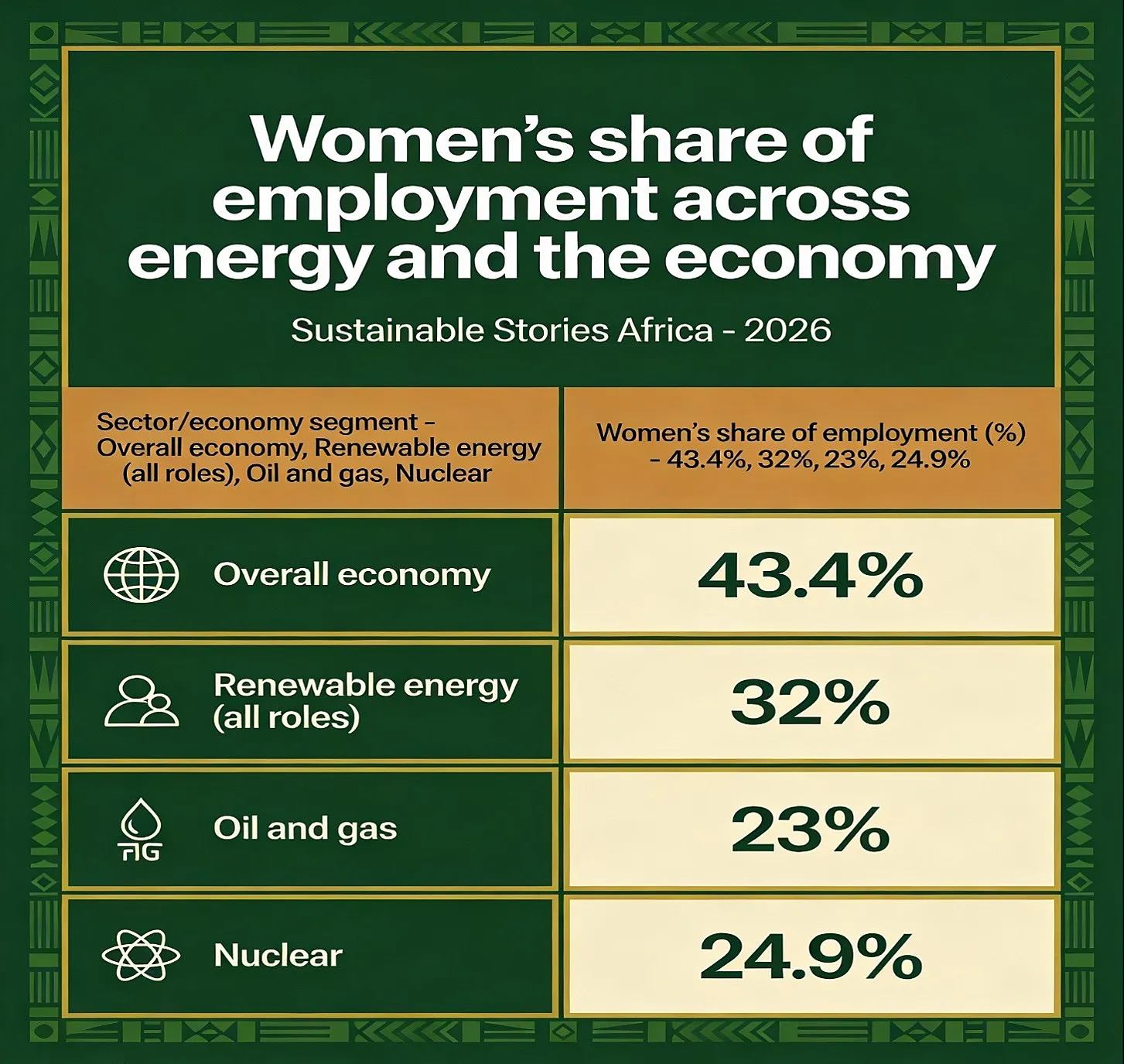
However, fresh global gender data from IRENA show that women still hold only 32% of full‑time jobs in renewables, better than oil and gas at about 23% and nuclear at 24.9%, but far below women's 43.4% share in the wider economy.
Behind that headline sits a stubborn segregation story. Women are most visible in administration, where they make up 45% of roles, and in non‑STEM technical positions at 36%. Their presence drops to 28% in STEM roles and just 22% in medium‑skilled trades.
In leadership, the gap widens further: women occupy only 26% of middle management and 19% of senior management or board positions, compared with roughly 31–35% of leadership roles across the overall economy.
Data reveal an unequal green boom
Counting women in the energy transition.
IRENA's second global gender survey spans organisations and individuals in 119 countries and areas, moving the debate beyond gigawatts to who actually benefits from the energy transition.
The study reaffirms that renewables outperform fossil and nuclear sectors in areas relating to gender diversity yet confirms that progress since the first 2019 assessment is incremental at best, particularly in technical and decision-making areas.
Regionally, women's share of full‑time renewable energy jobs clusters around the same modest average. Africa and Asia Pacific report about 33% female participation, Latin America and the Caribbean around 31%, while Europe and North America lag at roughly 27%.
The real divide is not geography, but where women sit in the value chain: across regions, they remain concentrated in support functions and underrepresented wherever STEM skills, fieldwork or final authority over capital and strategy are required.
Women's share of employment across energy and the economy
| Sector/economy segment | Women's share of employment (%) |
|---|---|
| Overall economy | 43.4% |
| Renewable energy (all roles) | 32% |
| Oil and gas | 23% |
| Nuclear | 24.9% |
Where women work, where they don't
Inside renewables' silent glass ceilings. The report's disaggregated role data strips away the illusion that a 32% average signals equity. In administrative positions, women almost reach parity at 45%, and they hold 36% of non‑STEM technical jobs such as legal, policy or sustainability advisory roles.
They are consistently underrepresented in the hands‑on and high‑powered segments that define long‑term influence and earnings.
In STEM‑intensive jobs
In STEM‑intensive jobs, such as engineers, grid specialists, and data analysts, women account for just 28% of staff, while only 22% of medium‑skilled roles like installers, machine operators and technicians are female, even though these are among the fastest‑growing jobs in the transition.
Senior leadership remains the sharpest fault line: women occupy 19% of top roles, compared with roughly 20% of energy leadership overall and more than 30% in the wider economy, highlighting renewables' failure to convert its diversity narrative into boardroom reality.
Women's share by role in renewables
| Role category | Women's share (%) |
|---|---|
| Administrative | 45% |
| Non‑STEM technical | 36% |
| Other roles | 29% |
| STEM technical | 28% |
| Medium‑skilled (trades) | 22% |
| Middle management | 26% |
| Senior management/board | 19% |
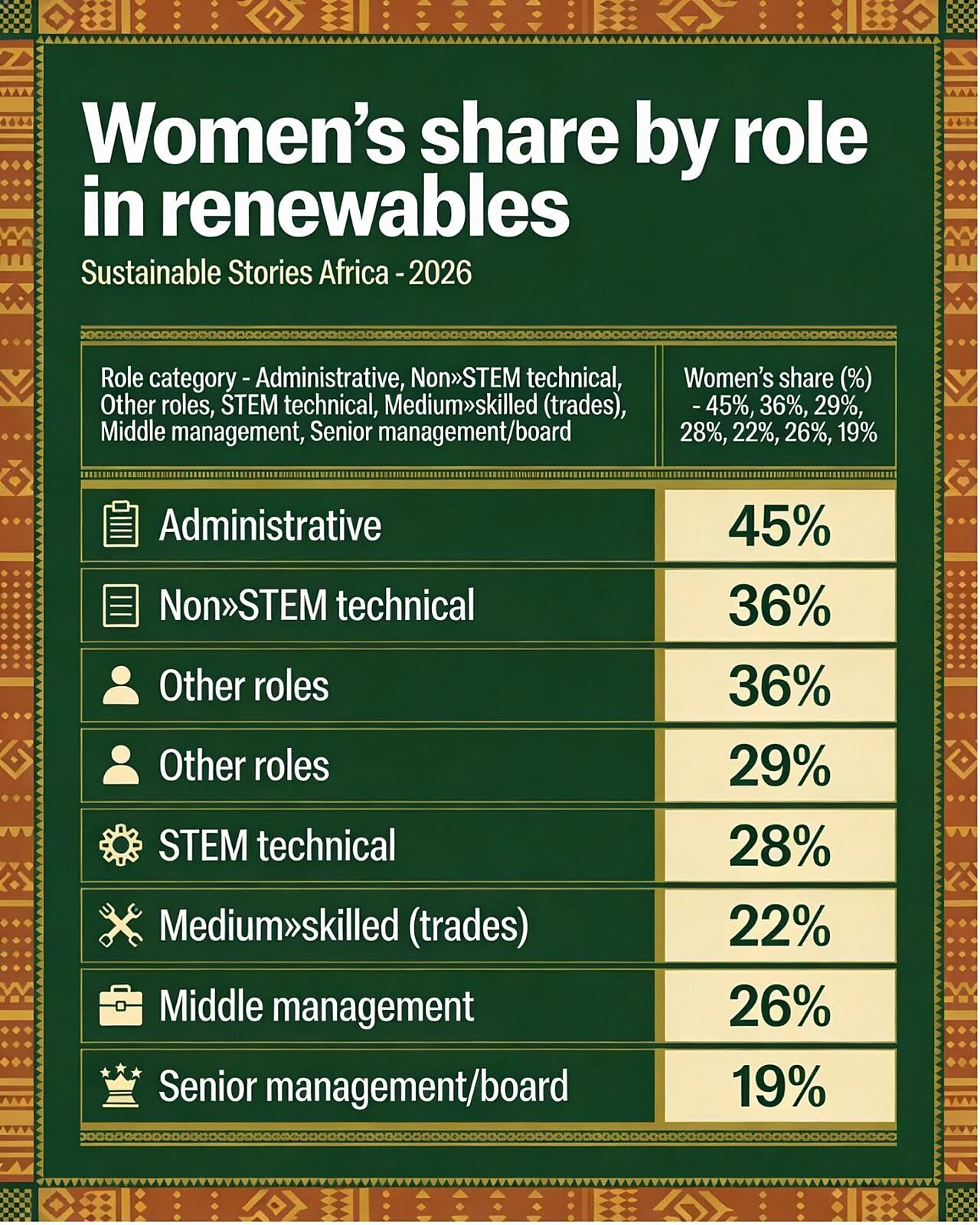
An internal comparison with economy‑wide benchmarks shows where the gaps bite hardest. Women's representation in renewable energy administration is about 13 percentage points higher than the female share in total employment, and non‑STEM technical roles sit roughly six points above the overall average, but women's share in senior management is about 15 percentage points lower than women's share in jobs across the wider economy.
Designing a just, data‑driven transition
Moving beyond token women in renewables.
The evidence provides insights that, without intentional design, the green transition risks embedding old inequalities in new infrastructure. Survey data shows that nearly 50% of women respondents report experiencing gender-based discrimination; however, only about 25% of incidents are reported, and just a third of those reports result in action. This attrition pipeline steadily drains talent from a sector that needs it most.
Women's under-representation extends beyond the payroll. It runs through STEM and TVET pathways, restrictive social norms, unequal unpaid care burdens, and constrained access to land, finance, and mobility. Where women are meaningfully engaged, such as in areas like sales agents, micro-grid operators, or clean-cooking entrepreneurs, outcomes improve, adoption rises, repayment strengthens, and technologies align better with local realities. However, such models remain the exception across off-grid and rural markets.
Well-designed interventions can bend the curve. Gender-responsive STEM and TVET scholarships, mentorship and sponsorship programmes, leadership targets, and transparent pay and promotion tracking all correlate with stronger diversity outcomes. Embedding gender indicators into SDG 7 tracking, national energy plans, NDCs, and green industrial strategies would begin to correct a persistent blind spot.
Three life‑cycle fixes for energy employers
Recruit, retain, advance with equity baked in.
The report frames the challenge across three career stages: recruitment, retention, and advancement, showing how barriers reinforce one another across the employment life cycle. Recruitment remains constrained by leaky education-to-employment pipelines, low female participation in STEM disciplines, and weak links between training programmes and actual jobs in the renewables sector.
To strengthen recruitment, the study highlights targeted STEM and TVET interventions for girls and young women, including scholarships, internships, and industry–academia partnerships that connect classroom learning to live project sites. Retention, which is identified as the most severe bottleneck, requires institutionalised care-friendly policies, safe and harassment-free workplaces, and gender-responsive management training, as unpaid care burdens and hostile cultures continue to drive exits.
For advancement, the evidence supports structured mentorship and sponsorship, leadership training, and formal gender targets in senior roles, underpinned by rigorous gender-disaggregated tracking. Organisations with stronger female representation in middle management show the clearest correlation with higher overall female employment.
Path Forward – Shared power in tomorrow's clean grids
Shared power in tomorrow's clean grids. IRENA's "way forward" reads less like a diversity add-on and more like a design brief for a just transition, from top-down, bottom-up, and cross-cutting. It embeds gender equity across energy policy, finance, procurement, and operations, anchored in institutionalised gender-disaggregated data used for budgeting, regulation, and accountability.
The roadmap extends beyond energy ministries. Governments, employers, unions, educators, and civil society must shift norms, rebalance unpaid care, confront gender-based violence, and elevate women's leadership. With the workforce set to double by 2030, the choice is between scaling equity or entrenching exclusion.
A clear warning
Success is not measured in megawatts alone, but in whether a decarbonised economy is co-designed, co-governed, and lived equally by women and men.