Malawi's agricultural challenge is often framed around climate shocks and low productivity. However, an equally binding constraint lies beneath the surface: limited access to reliable, affordable energy across rural value chains.
A new IRENA assessment shows that decentralised renewable energy, such as solar pumps, cold storage and processing systems, could unlock productivity, cut post-harvest losses and reshape incomes for millions of smallholder farmers across Malawi.
When Energy Shapes Farm Economics
Agriculture accounts for 23% of Malawi's GDP and employs 77% of the workforce, yet remains overwhelmingly rain-fed, labour-intensive and vulnerable to climate shocks. At the heart of this fragility is energy poverty.
Only 18% of Malawi's population has access to electricity, leaving most rural farmers dependent on manual labour, diesel pumps or traditional biomass for production and processing.
The consequences are visible across the food system: irrigation schemes lying idle due to high tariffs, milk spoiling before reaching markets, vegetables rotting without cold storage, and fish losses caused by weak preservation infrastructure. Energy scarcity, more than land or labour, has become a binding constraint on productivity.
A new policy-focused assessment by the International Renewable Energy Agency (IRENA) argues that decentralised renewable energy (DRE) could fundamentally change this equation—turning energy access into a catalyst for food security, climate resilience and rural incomes.
Energy Poverty Is Agriculture's Weakest Link
Malawi's farmers face a paradox: strong willingness to invest in productivity, but limited tools to do so. IRENA's fieldwork reveals that across key value chains—olericulture, dairy, rice, legumes and aquaculture—energy insecurity directly drives income losses.
In the dairy sector, 52% of farmers lack electricity, while 41% of milk produced spoils before reaching markets, translating into monthly income losses of roughly USD 24 per farmer. In rice irrigation, farmers report electricity bills averaging USD 576 per month, forcing irrigation schemes such as Lifuwu to operate at just 18% of capacity.
These losses are not marginal inefficiencies. They represent systemic leakage across Malawi's food economy, one that renewable energy could decisively address.
What the Data Reveals About DRE's Market Potential
IRENA's assessment maps energy needs across entire agricultural value chains, identifying high-impact entry points where decentralised renewables deliver immediate economic returns.
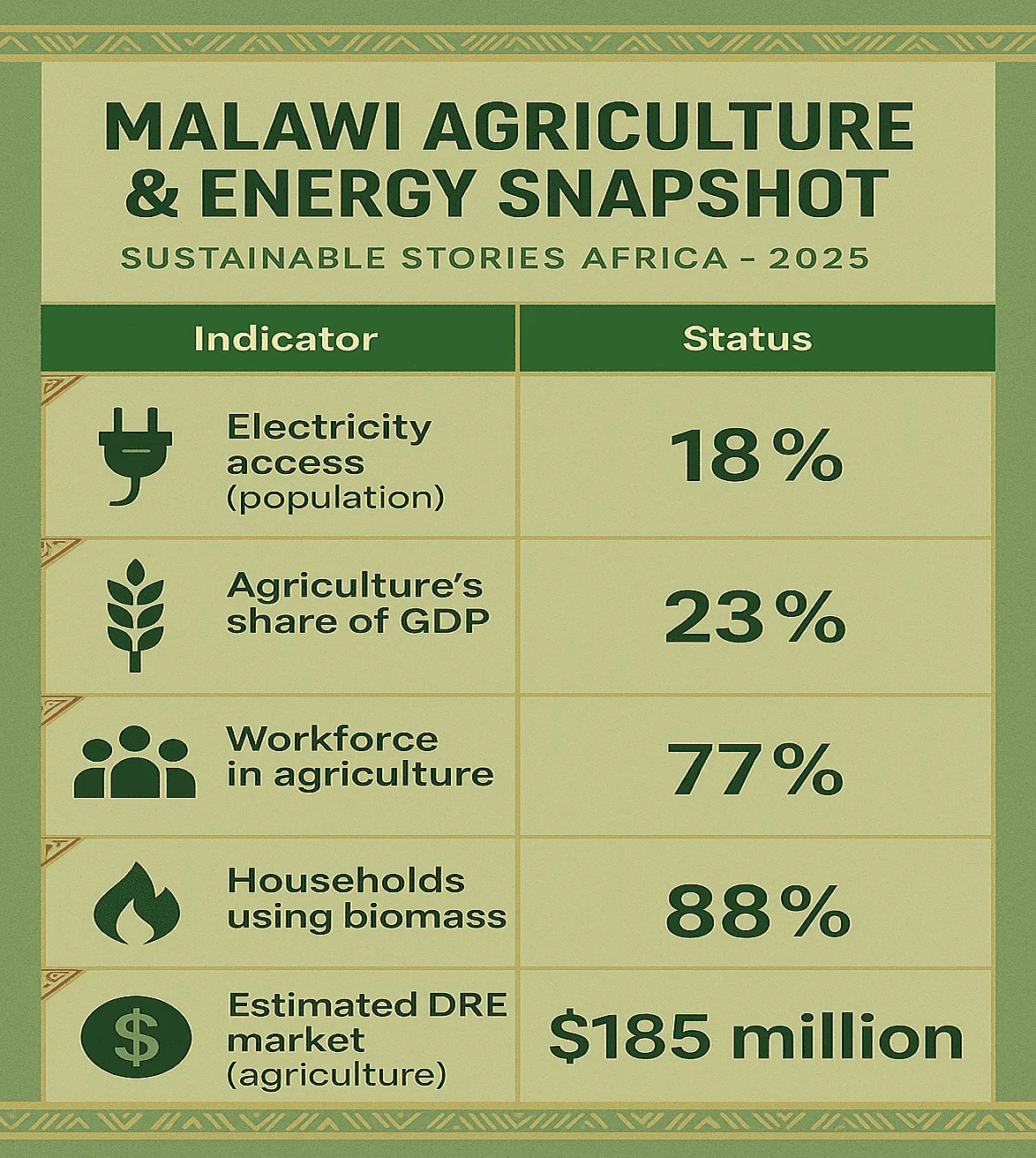
Malawi Agriculture & Energy Snapshot
| Indicator | Status |
|---|---|
| Electricity access (population) | 18% |
| Agriculture's share of GDP | 23% |
| Workforce in agriculture | 77% |
| Households using biomass | 88% |
| Estimated DRE market (agriculture) | $185 million |
The study estimates that $183.85 million in targeted investment could integrate DRE solutions across five priority value chains, unlocking irrigation, cold storage, processing and mechanisation where they matter most.
Why Decentralised Renewables Outperform the Grid
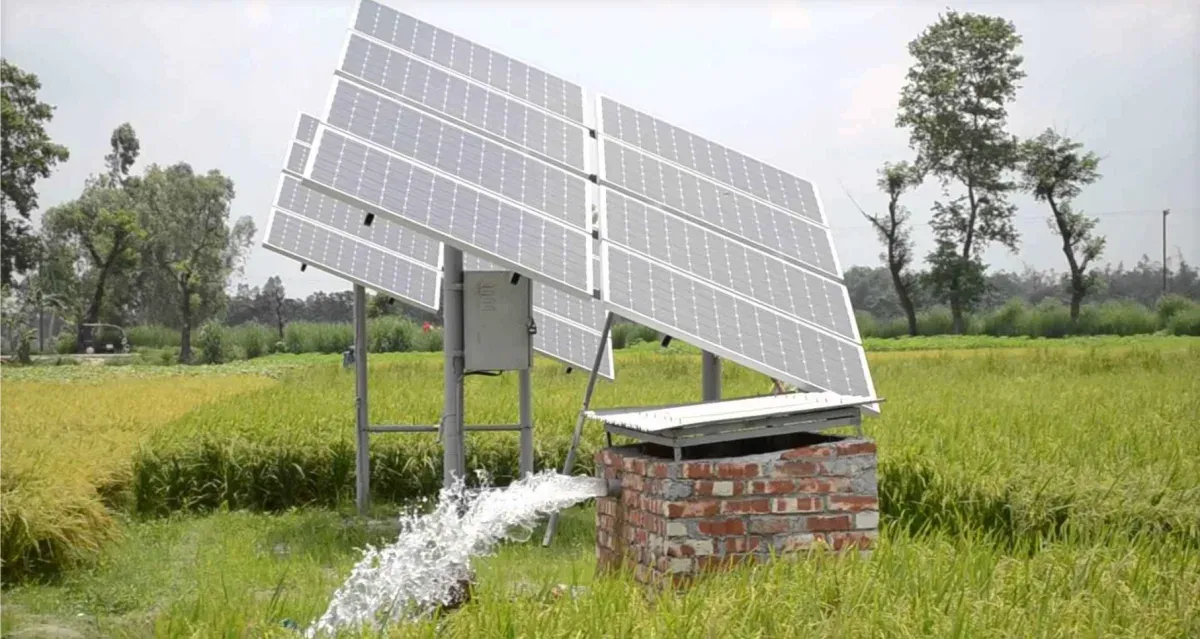
Centralised grid expansion alone cannot meet Malawi's agricultural needs fast enough. High tariffs, weak reliability and long connection timelines leave farmers exposed. DRE solutions, such as solar water pumps, dryers, cold rooms and mini-processing units, offer faster, modular and climate-resilient alternatives.
DRE Technologies by Value Chain
| Value Chain | Key DRE Solutions | Indicative Cost (USD) |
|---|---|---|
| Olericulture | Solar pumps, dryers, and cold rooms | $500 - $60,000 |
| Dairy | Solar fridges, milk coolers | $750 - $60,000 |
| Rice | Solar pumps, dryers, threshers | $500 - $5,000 |
| Legumes | Solar milling, drying | $500 - $5,000 |
| Aquaculture | Solar pumps, aerators, and cooling | $500 - $1,500 |
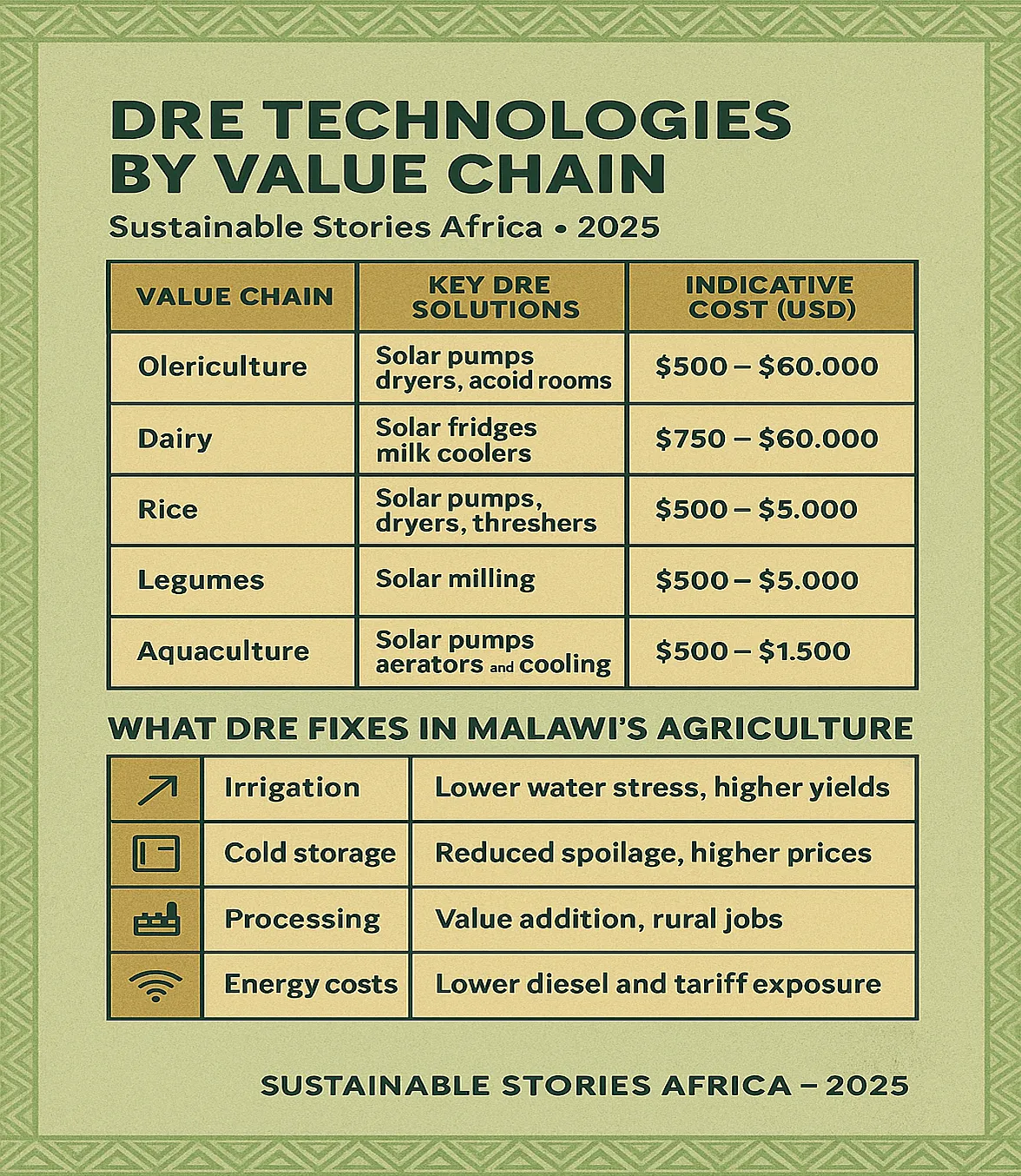
However, the economics are nuanced. Case studies show internal rates of return (IRRs) of 2 - 4% for early DRE adopters, quite low without policy support. IRENA therefore frames DRE not as a purely commercial play, but as a strategic infrastructure which requires tax relief, concessional finance and aggregation models.
Value Chains Where Energy Delivers Fastest Gains
- Olericulture: Cutting Post-Harvest Losses – Solar-powered irrigation and cold storage could reduce vegetable spoilage by over 30%, boosting incomes and stabilising market supply. Traders report willingness to pay $1 per day for cold storage, suggesting immediate demand once infrastructure is available.
- Dairy: Stabilising Rural Incomes – Milk bulking groups lose 4,830 litres per month due to outages, costing nearly $900. Solar cooling tanks could eliminate these losses while lowering diesel dependence.
- Rice & Legumes: Unlocking Irrigation and Processing – Solar pumps reduce reliance on expensive grid electricity and diesel, enabling double cropping and higher yields. Solar dryers and threshers improve quality and reduce breakage, key to export competitiveness.
- Aquaculture: Year-Round Production – Solar aerators, pumps and refrigeration enable continuous fish production, improving protein supply and rural employment, particularly for women and youth.
PATH FORWARD – Powering Farms, Securing Food Futures
Malawi's agricultural transformation depends on energy access as much as seeds or rainfall. Decentralised renewables offer a practical pathway to raise productivity, reduce losses and stabilise farmer incomes.
By combining tax incentives, concessional finance and co-operative delivery models, Malawi can turn DRE into a backbone of climate-resilient agriculture, aligning Vision 2063 with real gains for smallholder farmers.