Zimbabwe's agriculture sector sits at a decisive crossroads. Climate volatility, weak grid access and rising input costs are eroding productivity across value chains that sustain 70% of the population.
A new IRENA assessment shows decentralised renewable energy could unlock billions in value, lifting yields, cutting post-harvest losses and reshaping rural livelihoods—if finance, policy and delivery models align fast enough.
Energy Is Farming's Missing Input
Agriculture remains Zimbabwe's economic backbone, contributing up to 14% of GDP, employing more than half of the workforce and feeding seven in every ten citizens. However, beneath this centrality lies a structural weakness that no amount of fertiliser or seed improvement can fix alone: energy poverty.
Only 12% of smallholder farmers are connected to the national grid. The rest rely on rainfall, firewood and diesel. Inputs have become increasingly unreliable, expensive and environmentally destructive.
The result is a system where irrigation is absent, cold storage is rare, post-harvest losses routinely exceed 30%, and women and youth shoulder the heaviest labour burden.
A new assessment by the International Renewable Energy Agency (IRENA), conducted with Zimbabwean ministries, argues that the constraint is no longer technology.
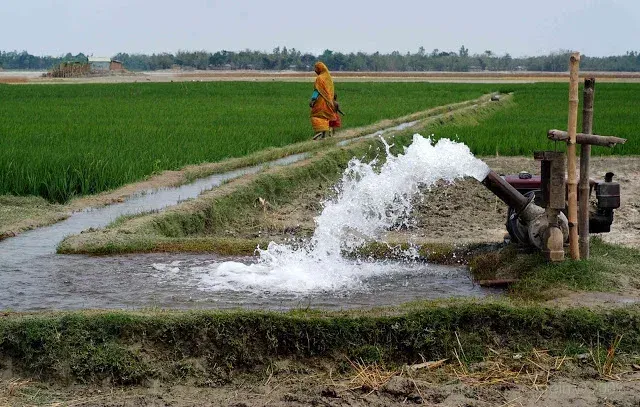
Solar pumps, cold rooms, dryers and processing equipment are commercially viable today. The real question is whether Zimbabwe can mobilise finance, policy coherence and delivery models quickly enough to convert decentralised renewable energy from pilot projects into a national productivity engine.
Agriculture's Energy Deficit Is Costing Billions
The data are stark. Agriculture produces 70% of Zimbabwe's staple foods, yet 84% of rural households lack electricity. More than 75% of farmers identify water access as their biggest productivity constraint, while up to half of the harvested produce is lost during hot seasons due to inadequate storage.
IRENA estimates the addressable market for decentralised renewable energy (DRE) in agriculture at over $7.2 billion, driven largely by solar-powered irrigation aligned with government plans to expand irrigated land to two million hectares. Solar cold storage adds another $128 million opportunity, with solar dryers contributing an additional $13 million.
Crucially, these are not speculative technologies. Payback periods range from one to six years, with yield gains exceeding 30% and post-harvest losses falling by at least 50% in several value chains.
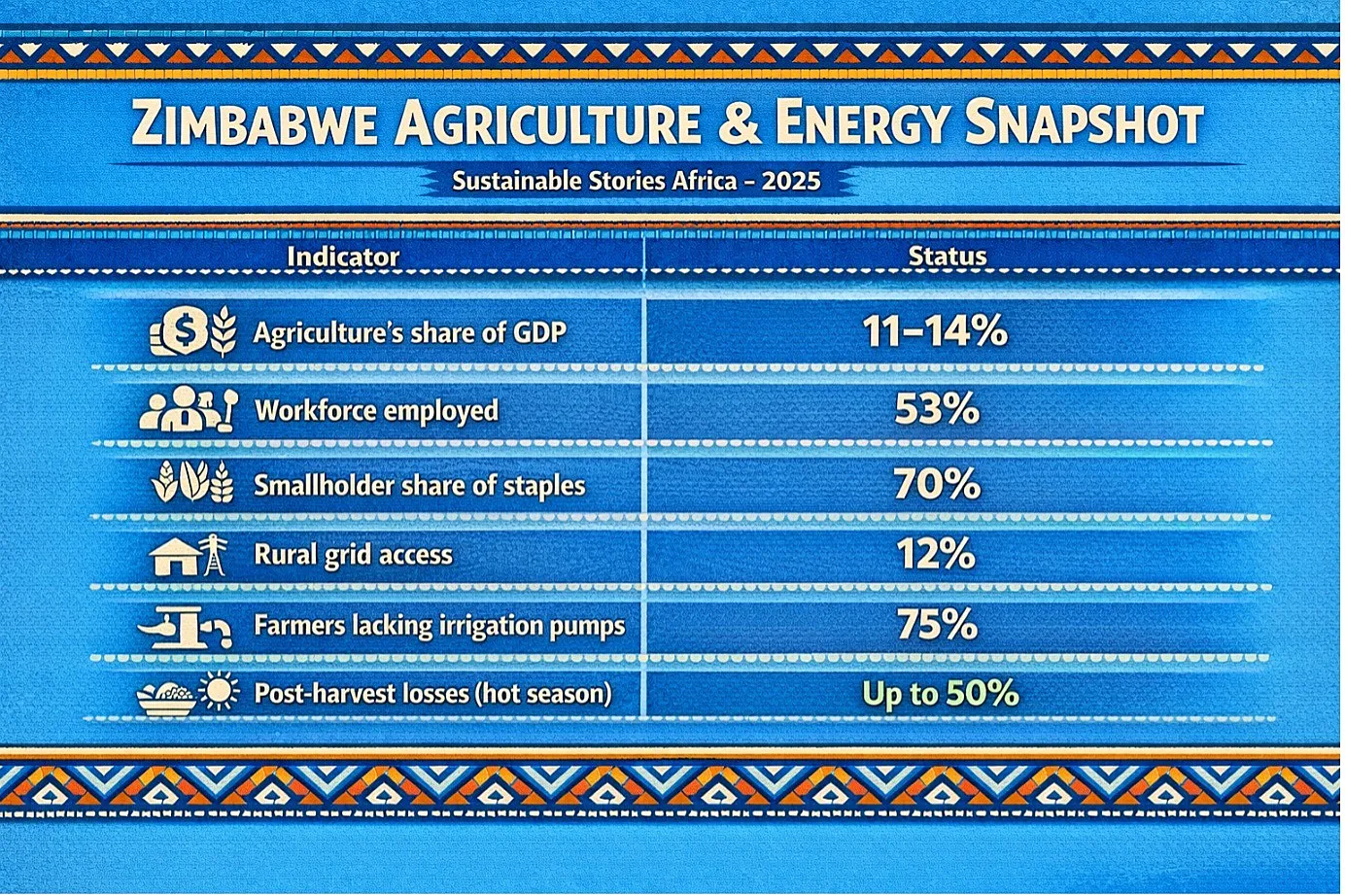
Zimbabwe Agriculture & Energy Snapshot
| Indicator | Status |
|---|---|
| Agriculture's share of GDP | 11–14% |
| Workforce employed | 53% |
| Smallholder share of staples | 70% |
| Rural grid access | 12% |
| Farmers lacking irrigation pumps | 75% |
| Post-harvest losses (hot season) | Up to 50% |
Where Energy Unlocks the Value Chain
IRENA's analysis tracks energy needs "from farm to fork" across five priority value chains: maize, groundnuts, tomatoes, mangoes and aquaculture. Each reveals similar choke points and similar solutions.
- Maize, grown on two million hectares, averages just 1.39 tonnes per hectare. Solar irrigation alone can more than double productivity, while solar dryers and shellers cut labour intensity and reduce losses of 20–30%.
- Horticulture suffers even sharper inefficiencies. Tomatoes and mangoes face post-harvest losses of 30–55% due to absent cold chains. A 21 m³ solar-powered refrigerated container costing about USD 5,500 can extend shelf life by weeks, stabilise prices and open processing markets.
- Aquaculture, a growing protein source, remains constrained by unreliable water pumping, aeration and cold storage—constraints solvable with integrated solar systems costing under USD 10,000 per site.
Across all chains, the same pattern emerges: modest energy interventions unlock disproportionate economic returns.
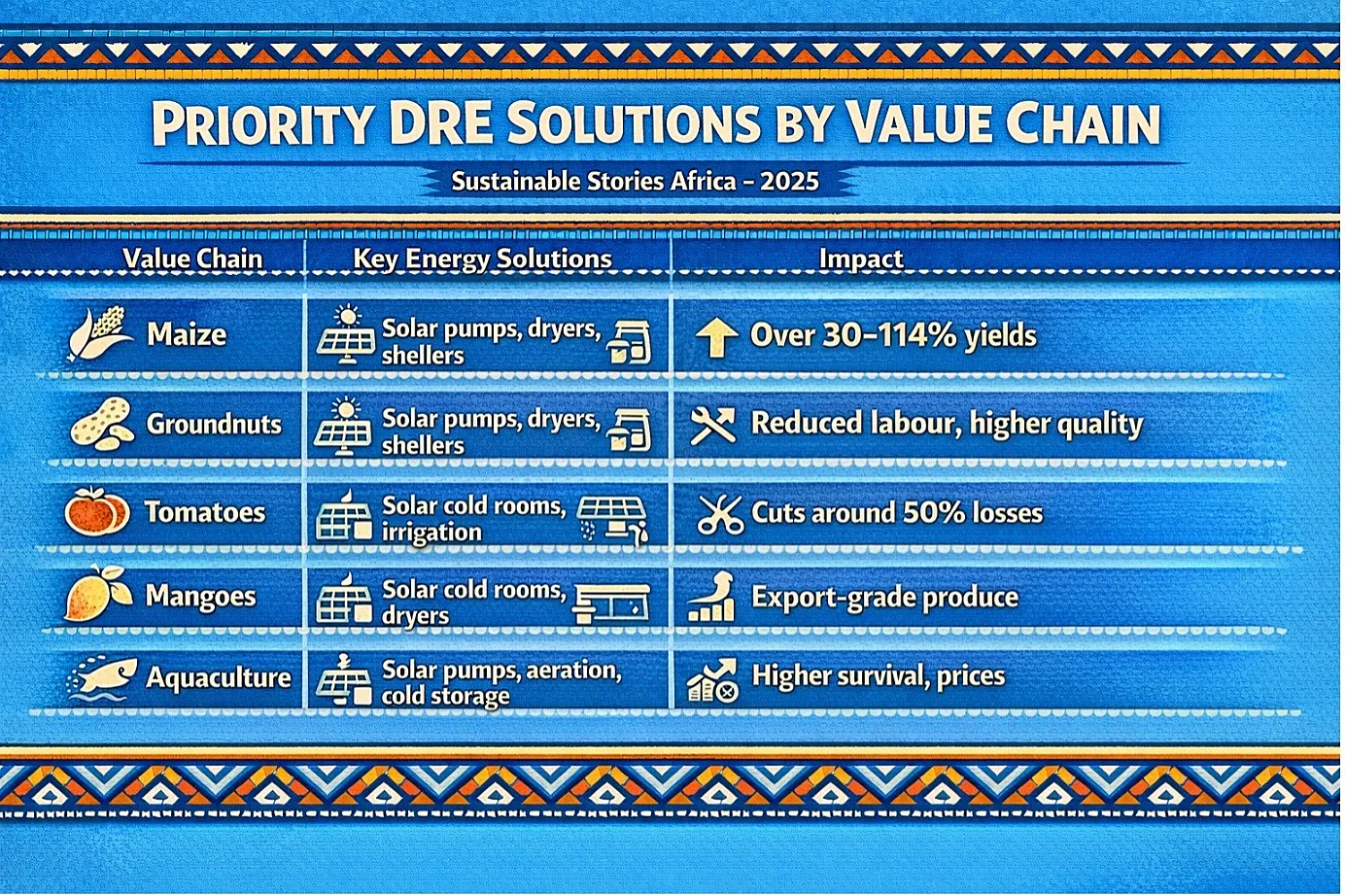
Priority DRE Solutions by Value Chain
| Value Chain | Key Energy Solutions | Impact |
|---|---|---|
| Maize | Solar pumps, dryers, shellers | Over 30–114% yields |
| Groundnuts | Solar pumps, dryers, shellers | Reduced labour, higher quality |
| Tomatoes | Solar cold rooms, irrigation | Cuts around 50% losses |
| Mangoes | Solar cold rooms, dryers | Export-grade produce |
| Aquaculture | Solar pumps, aeration, cold storage | Higher survival, prices |
The Productivity, Gender and Climate Dividend
The promise extends beyond yields. Renewable energy reshapes rural economies.
Women, who dominate post-harvest processing, spend less time on manual drying and firewood collection. Youth gain entry points into energy-enabled agribusiness, from cold-storage hubs to processing units. Emissions fall as diesel pumps and biomass cooking decline.
Scenario modelling shows that under rapid DRE adoption, Zimbabwe could unlock over $2.5 billion annually in additional agricultural value, while building climate resilience aligned with Vision 2030 and national climate commitments.
The implication is clear: decentralised renewables are no longer an energy policy issue. They are a macroeconomic growth lever.
Finance, Policy and Delivery Must Converge
However, barriers remain stubborn. Up-front costs, limited rural finance, weak distribution networks and low awareness slow adoption. Microfinance rates of up to 15% per month make even profitable technologies inaccessible.
IRENA's recommendations converge on five actions:
- Dedicated DRE financing windows and guarantees
- Value-chain-linked equipment finance
- Community ownership models
- Nationwide awareness campaigns
- Enforced quality standards
Without these, solar pumps risk remaining isolated success stories rather than systemic solutions.
PATH FORWARD – Powering Farms, Financing Futures Together
Zimbabwe's agricultural transformation hinges on treating decentralised renewable energy as core infrastructure, not auxiliary support. Solar irrigation, cold storage and processing must be financed, regulated and scaled with the same urgency as roads and dams.
The prize is tangible: higher yields, lower losses, empowered women and youth, and a climate-resilient food system capable of restoring Zimbabwe's role as Southern Africa's breadbasket, this time powered by the sun.